Wednesday, July 26, 2006

Proximity Passport Perception Problems Persist

Image Credit: theducks.org/© 1995-2006 Alex Dawson

Radio Frequency Identification (RFID) enabled passports have many inherent benefits, however, some fears of identity theft and other potential information breech perceptions exist.

The confusion and concerns about the potential of anyone being able to retrieve private, personal information "from a distance" may just be a matter of education - says an ABI Research Report.

Excerpts from eWEEK -

Report: DHS Should Soothe RFID Passport Fears
The upcoming U.S. e-passports are still giving rise to privacy concerns; ABI Research recommends that the government speak up about the technology.
By Renee Boucher Ferguson - eWEEK - July 25, 2006


There is a lot of miscommunication regarding the security and privacy of the U.S. government's new RFID-based e-passports, according to ABI Research Analyst Sarah Shah.

ABI Research released a report July 25 that suggests that the Department of Homeland Security, which will issue the e-passports in conjunction with the State Department starting in August, should speak out to reassure the public about the safety of contactless technologies.

The U.S. government plans to implement contactless technology, which is essentially data transmission that is activated by waving a reader over an RFID (radio-frequency identification) chip that has a tiny embedded antenna, in all electronic passports by the end of 2006.

"There are uneducated claims being made by some privacy advocates," said Shah, in Oyster Bay, N.Y. "They make claims such as, 'If you have a contactless chip in your passport [the government] can track you everywhere and they'll know everything about you.' This is simply not true, and the DHS should publicly explain what the technology is capable of, and why it's secure."

Since the State Department announced in 2005 that it would issue RFID-chipped passports by the end of 2006 to all passport agencies, security and privacy advocates have been up in arms.
The concern is that the data stored on the chips - including name, address, nationality and date of birth—will be accessible not only to customs agents, but to anyone with the wherewithal to hook up a reader and go scanning (or skimming, as the case may be) for information. The tiny silicon-based RFID chips that will be embedded in the passports themselves contain embedded antennas, which transmit data once a specially designed RFID reader is waved in front of it. One issue is the range at which the readers can access data.


"Our concerns extend beyond the passports," said privacy advocate Katherine Albrecht, co-author of "Spychips: How Major Corporations and Government Plan to Track Your Every Move with RFID," during a May 26 interview with eWEEK. "At a recent conference calling for RFID tags in identity documents [some speakers] were talking about the tags being read from 20 to 30 feet away. We were actually quite stunned by that."

Kevin Ashton, the co-founder of MIT's Auto ID-Labs, the research center that essentially founded a global RFID network and standard that has since become EPCglobal, is against the idea of using RFID chips in passports.

"The idea of storing all this sensitive data [in passports] is horrible. You can take the chip off one passport and stick it on another. No one will know the difference," said Ashton, now vice president of marketing at ThingMagic, in Cambridge, Mass., and a professor teaching RFID classes at MIT. "My big issue is it is truly a stupid idea to store any information on an RFID tag other than a unique number. Otherwise there is always the risk of data change."

Ashton suggested that the way the e-passport's RFID technology should work - if it has to be there at all - is to have a chip that stores a unique number that can only be authorized by those people who should have access to it. The number would refer back to data stored in a secure database. The only information anyone should be able to find on the passport, he said, is a photo.

----
Bruce Schneier, a well-known security technologist and author, said during a May 26 interview with eWEEK that eavesdropping will only get easier.

The DHS has implemented some security and privacy devices on the e-passport chips: a metal shielding device on the passport's front cover that prevents the data from being read when it's closed, and BAC [basic access control] technology to prevent skimming and eavesdropping of data. Schneier said the precautions are good, but not good enough.

"Shielding is good. Basic access control is good. Putting a switch would be great," said Schneier, in Mountain View, Calif. "But if you don't have RFID you don't need any of this. I haven't seen any compelling reasons why we are doing this. If we [the government] did it out in the open then everyone would scream."

----
"The public has pretty overwhelmingly said they don't want RFID in documents, yet [the government] plowed ahead with it anyway," Albrecht said.

ABI Research said the bottom line is that the ongoing security and privacy debates probably will not have an impact on the DHS' decision to issue e-passports in August.

"We feel that the DHS should take steps to mitigate public concerns today," Shah said.

Read All>>

RFID may sound like a good idea for automating the process of identification through our nation's checkpoints, but when it comes to the internal security of our country and the protection of our identity ... this just isn't the same application process as a "Mobil Speedpass" or a freeway tollway access payment verification.

Typical, the federal government remains clueless to the real issues that surround the application of this proximity technology.

As in real estate (location, location, location) the axiom for the implementation of a new technology is "application, application, application!"


UPDATE (August 21, 2006):
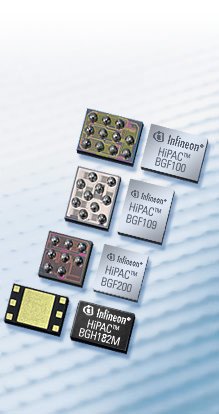
New US Passports Contain Secure Identification Chips from Infineon; Advanced Technology Meets International Standard for Secure Travel Documents Image Credit: Infineon Technologies AG

Infineon to supply chip for U.S. e-passports
U.S. set to begin issuing passports equipped with RFID chips containing biometric data
By John Blau, IDG News Service - August 21, 2006

German chip maker Infineon Technologies will supply chips for new electronic passports that the U.S. will begin issuing in the coming weeks.

Of the 15 million e-passports to be issued by the end of the year, several million of them will be equipped with Infineon chips, the manufacturer said Monday.

The first wave of U.S. passports with chips, however, comes despite lingering privacy and security concerns. Earlier this month, a German security expert at the Black Hat security conference in Las Vegas demonstrated how e-passports -- equipped with an RFID (radio frequency identification) chip containing biometric data -- could be copied using a laptop computer, an RFID reader and smart card reader software.

The chip contained in each new U.S. passport issued from October will contain personal data, such as the bearer's name, date of birth, validity period, and a digital photo of the individual.

The e-passport, according to Infineon, is designed with multiple security levels, including the basic access control (BAC). This security feature requires the border control inspector to pass the document over a scanner that reads coded information and then authorizes the electronic reader to access the data stored on the chip. Data transmission occurs over a distance of only around four inches, or 10 centimeters.

More than 50 individual security mechanisms are inside the Infineon chip, including sophisticated computing methods for encrypting data. Protective shields on the surface of the chip and sensors also help prevent unauthorized people from being able to read the contents of the chip.

Infineon, which is located in Munich, is supplying chips for e-passport to several other countries, including Germany, Norway, and Sweden.
Link Here>>

Tuesday, July 25, 2006

Convenience Trumps Impulse Capitalism

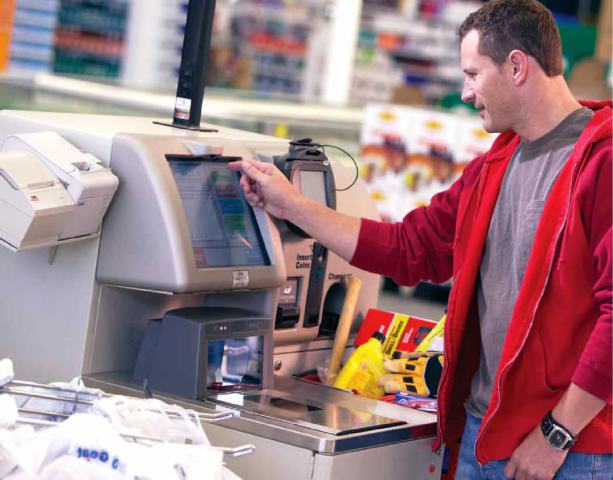
Image Credit: Fujitsu Transaction Solutions - USCAN

It turns out that when shoppers are into a pure "Hunter/Gatherer" mode of shopping (ie. get in - get it - and, get out), the impulse nature of decision shopping drops dramatically.

You know what you want and you run to the store to get the items, where do you choose to checkout and get on with your day? The self-checkout station, that's where. A place where there is elbow room, no racks to bump into, and a quick turn-around conclusion to your short shopping experience ... after all, you have better things to do.

This self-checkout thing has become a real problem to retailers, however. Now, some of us will not even shop in a store unless they offer a self-checkout option!

This from the New York Post -

QUICKIE CHECKOUT CUTS BUYS
By SUZANNE KAPNER - New York Post - July 25, 2006

Self-checkout aisles at supermarkets dramatically reduce impulse purchases of items like chocolates and magazines, a new study reveals.

Shoppers make last-minute purchases 45 percent less often when they use automated checkout machines, as opposed to waiting for a cashier to check them out, according to IHL Consulting Group.

The drop in impulse purchases was greater for women (50 percent), than for men (27.9 percent), according to IHL, which polled 533 people to determine their shopping habits.

IHL analyst Greg Buzek warned that companies like Hershey's, Wrigley's and Pepsico, which make many of the products that line supermarket check-out lanes, could face a drop in sales unless they figure out a way to better appeal to time-strapped consumers.

Some supermarket chains like Kroger and Meijer have addressed changing consumer behavior by adding items like rotisserie chicken and fresh baked breads to the front of stores, to entice shoppers through their sense of smell, as opposed to simply using visual displays, Buzek noted.

In 2005, consumers spent more than $110.9 billion in self-checkout transactions at retailers, up 35 percent from the prior year, IHL said.

However nearly 30 percent of respondents said they preferred cashiers, opting to only use self-checkout when lanes staffed by employees had long lines.

Read All>>

Have Scanner ... Will Shop!

Wednesday, July 19, 2006

"Food Deserts" Lead To Heightened Early Death Rates

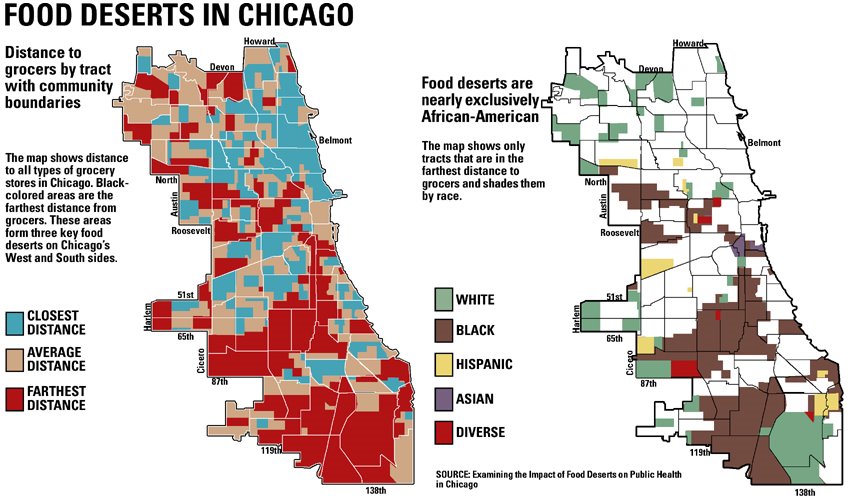
Researcher Mari Gallagher measured the distance to the nearest grocery and the nearest fast-food restaurant for every city block to come up with what she called a "food balance" score for each community area in Chicago. Image Credit: Chicago Sun-Times

A report titled, "Examining the Impact of Food Deserts on Public Health in Chicago," is believed to be the first to examine the correlation between population and the access to food in supermarkets. Further, this report follows past research by Gallagher looking at the distribution of chain supermarkets in Chicago and access to grocery stores as a function of income.

Excerpts from the Chicago Sun-Times via FMI Daily Lead -

Early deaths tied to lack of grocery stores
BY JANET RAUSA FULLER Staff Reporter - July 18, 2006

Chicagoans who live in areas with scant grocery stores and many fast-food restaurants are more likely to die prematurely and at greater rates from diabetes, cancer or heart disease, a study to be released today finds.

Residents of such "food deserts" -- clustered predominantly on the West and South sides -- also are more likely to be obese and suffer from hypertension, according to the study commissioned by LaSalle Bank.
----

Taking into account health data for those areas and holding race, income and education constant, Gallagher found that the more "out of balance" a community is in terms of food choices, the higher the prevalence of chronic health issues and diet-related deaths.

Diabetes rates more than double

African Americans, in particular, are "most disadvantaged when it comes to balanced food choices," her research found. They travel the farthest on average to any type of food store and tend to live in communities that make up three main clusters of food deserts in Chicago, according to the study.

The death rate from diabetes in the worst -- and predominantly black -- food deserts is more than twice that of other communities, the study found.

"I think the good news of this study is that it brings a new call to action for what can be done in these communities," Gallagher said. "We know that across the country, the black population generally has higher diet-related deaths and health disparities. Can you change somebody's genetics? Can you change somebody's eating preferences? Can you change somebody's income? Certainly there are some things along those lines that can be done . . . but the good news is you can probably even more easily locate a grocery store somewhere."

----
The areas with the highest concentrations of single mothers and children "is almost a one-on-one match" with areas designated as food deserts, the study found.

Obesity also said to be related

The study, which will be the focus of a forum today at the Palmer House Hilton, also makes a correlation between the location of grocery stores and body mass index, suggesting that, "as grocery store access decreases, obesity increases." The West and South sides have the highest obesity rates, while the North and Northwest sides have the lowest rates, the study found. Gallagher said the addition of even a single grocery store in an area where there are few to none could lower obesity rates.

Read All>>

Why Symblogogy? -- If you are not scanning, you are not living!

Wednesday, July 12, 2006

2 Fingers, Or 3? ... The Accountability Of RFID

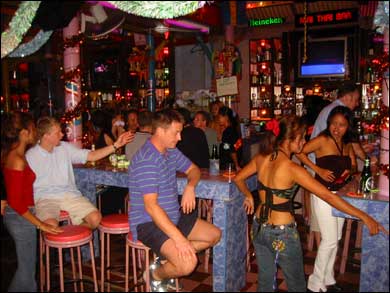
Typical bar scene at the Mai Thai Bar - Patong beach - Phuket Thailand. Image Credit: phuketwatch.com

RFID (Radio Frequency Identification) tag technology has come a long way from just being a tool to log if something or someone has passed through a reader field so that one knows if the object has been tracked to its present location or not.

Now, there are tags that record the movements and duration (time) the tagged object was moved so that one could make assessments as to what was happening with the tagged object without actually watching exactly what had happened to be informed.

These tags are now being applied to liquor bottles to aid the owner as to the efficiency of the bartending staff. These tags track the angle movement of the bottle to be poured and logs the amount of time the bottle is in this position, and with software, the manager is able to determine how much was actually poured and served to the bar customer.

So, when the bartender asks you, "Is it 2 fingers, or 3? ... What he/she really means is - is it a two or three second "tilt" from the RFID-tagged bottle.

Excerpts from eWEEK -

Bartending, RFID Style
By Evan Schuman, Ziff Davis Internet - July 11, 2006

On a busy Saturday night, a good bartender makes a lot of money for the bar's owner, but an overly generous bartender - or one fond of pouring free drinks for friends - can cost the owner even more.

A Miami-based 7-year-old beverage-monitoring software company is drinking from the keg of RFID and is selling a tilt switch that attaches to bottles and updates an Internet database every time the bottle is poured. Hilton, Hyatt, Outback Steakhouse, TGI Fridays and others are reportedly testing the system.

It's not merely recording how many times the bottle is poured, but it factors in the tilt of the bottle, the duration of the pour and the bartender's pouring style to calculate how much liquid is leaving the bottle.

"The software converts the tilt into an estimated volume, and the conversion is automatically perfected based on the history of each bottle; hence it becomes more accurate over time and adapts to each bartender's habits. When the bottle is empty, our sensor knows it and the software readjusts the historical pours of each bottle to the known volume of the bottle," said Beverage Metrics CEO David Teller, who said his company has between $5 million and $10 million in annual revenue. "Our system reconciles pours to ring-ups and recipes and automatically decides what is a long pour that should be changed to two pours [and] when to combine short pours in sequence."

Because the server that watches the tilt-tracking RFID system also tracks the POS (point-of-sale) system, it can also know what ingredients bartenders are using to make drinks and whether they are following the authorized recipes in addition to whether they are pouring too much or too little.

Teller said he expects the sensors to eventually sell for "less than $2 with housing, attachment means, on/off switch, tilt switch, TI micro, five-year battery and RF circuit." Right now, though, the price is closer to $5 plus a subscription fee roughly equivalent to about 1 percent of revenue, Teller said.
----
Although the system's readers have a range of about 50 feet, Teller said a bartender can't outsmart the system by pouring a drink beyond the range of the sensor - or simply disabling the sensor - because all of the tags are in periodic contact with the server.

"It issues an alert if the tag is removed," he said. "If the sensor doesn't ping, 'Hey, I'm here' after an hour, we start paying attention to that guy."

John Fontanella, an RFID analyst with the Aberdeen Group, dubbed Teller's system "an interesting idea" but wondered whether wireless rings around the bottles would scare off customers and chill some of the bartender-drinker relationship.

----
But Fontanella is even more cynical about whether it will truly minimize theft. "I'm already thinking about how bartenders will beat this," he said. "They will find a way."
Read All>>

Thursday, July 06, 2006

RFID Privacy Guidelines - Like Catching JELL-O.

Jell-O Trivia: March 17, 1993, technicians at St. Jerome hospital in Batavia test a bowl of lime Jell-O with an EEG machine and confirm the earlier testing by Dr. Adrian Upton that a bowl of wiggly Jell-O has brain waves identical to those of adult men and women. Image and Information Credit: LeRoy Historical Society/JELL-O Museum

The Canadian province of Ontario recently issued guidelines on how companies, using RFID in consumer based applications, should always consider the privacy of the individual consumer's information gathered and how it can or should be used.

The guidelines were issued by the Information and Privacy Commissioner/Ontario - Ann Cavoukian, Ph.D., Commissioner, in June - and were intended to serve as privacy "best practices" guidance for organizations when designing and operating Radio-Frequency Identification (RFID) information technologies and systems.

The problem comes when a company is already using information gathered via barcode, how does one square these privacy guidelines with the company's current loyalty program and advertising methods.

There's more.

Excerpts from an opinion issued by eWEEK -

Canadian Province's New RFID Privacy Guidelines Could Have the Wrong Effect
By Evan Schuman, Ziff Davis Internet - June 22, 2006


The commissioner for Information and Privacy in Ontario unveiled June 19 a series of tips and guidelines for using RFID within her part of Canada.
----
The guidelines themselves certainly need to be examined seriously, because North American products can ill afford to accommodate two different standards, and besides, neither Mexico nor the United States has any material privacy RFID rules at the moment.

Current U.S. views on RFID privacy pretty much come down to a modified monetary laissez-faire policy ("leave campaign contributors alone and the market will take care of itself"), while Mexico's position is closer to "You can capture anything about our citizens that you want as long as you pay a living wage. OK, one-fourth a living wage, but we want a break after 18 hours of work."

The Ontario approach is a bit different. One example: "Organizations should only collect, use or disclose RFID-linked personal information for purposes that a 'reasonable person' would consider appropriate in the circumstances."


It then lists two things that Ontario believes would be unreasonable: "price discrimination" and "tracking and profiling individuals without their informed, written consent."

The "price discrimination" is aimed at applications that will charge lower prices to customers they want to attract and higher prices for those they want to repel, such as aggressive bargain hunters.

There have been unsubstantiated allegations about this on some Web sites, but those allegations involved cookies, not RFID.

Still, the potential exists for RFID to enable the same kind of capability. But isn't this simply a continuation of the time-honored discounts for those with a frequent shopper loyalty card?

Aren't those card programs offering discriminatory pricing, in the sense that some customers are being charged different prices than others?

That gets into that second reference: " tracking and profiling individuals without their informed, written consent."

Is this to be interpreted to mean that such tracking/profiling is permitted in Ontario, as long as it doesn't involve RFID?

It would seem silly to permit it for CRM programs as long as they used barcodes, but to somehow find the privacy invasion reprehensible if it involves RFID.


Tracking and profiling are fighting words. Is it profiling to offer discounts on one brand of peanut butter only for people who regularly purchase a particular competing brand?

Is it tracking to note that one consumer spends more than $900 per month typically and then to send them e-mail invitations to some event?

The wording in the Canadian material doesn't exclude aggregate data, but isn't that based on tracking individuals? Is that prohibited as well?

----
Here's a well-intentioned one: "Organizations should not use or disclose RFID-linked consumer information for any purpose to which the individual has not consented."

The only problem is that retailers will likely throw such language into the fine print on the back of every loyalty card, check-cashing card or anything else, including credit card slips.

As long as fine print exists on unrelated documents, such consumer consent will have little value.

It's certainly a good thing that some government officials are thinking through where RFID could go in terms of consumer protections.

But government edicts without industry support won't help much.

----
Back in December 2004, U.S. Senator Chuck Schumer called a news conference to promise legislation to regulate how retailers handle return policies. That legislation was never introduced.

Although Schumer's office has never officially explained what happened, some who were working on the legislation said that it became quite difficult to legislate wording and policy on something so customizable and also so proprietary.

In other words, the exact methodology to determine excessive returns could be thwarted if fraudsters knew the particulars.

----
There is a common thread between the two. On a surface level, forcing return policies and RFID tracking policies to be public sounds like a good thing, but digging down deeper, it's very complicated to do it in a meaningful way that will actually advance the public cause.

Will government leaders score points by announcing rules and then abandon their efforts without enforcement?


Updated: Opinion: Warning consumers about anything presupposes that there is something bad about that item, something that should be avoided. This might be a self-fulfilling prophecy.
Read All>>

Consumer based RFID applications will always require critical review of their intended results and eventual consent by consumer privacy advocacy groups as to the benefits derived.

Tuesday, July 04, 2006

Grocery Database Errors vs. Price-Scanner Errors

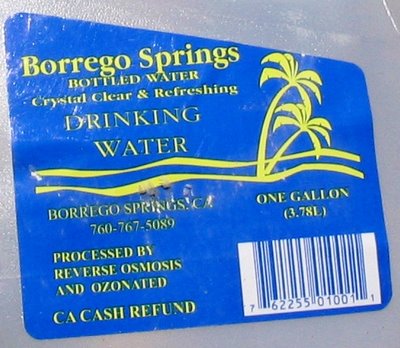
Label with Universal Product Code (UPC) barcode. Borrego Springs Bottled Water distributed throughout San Diego County in Southern California. Image Credit: ecj

This issue of terminology is really getting out-of-hand. The terminology in question is the use of "Price-Scanner Errors" when the price on the shelf and/or the price sticker on a product does not match-up with the price stored in the database when the product is passed over the barcode scanner at checkout.

The terminology suggests that the problem with the difference in the price rests with the lowly input device ... the barcode scanner ... that the scanner has transmitted errors in the price.

It never fails that the Main Stream Media (MSM) packages a story to be broadcast around the Holidays warning of this evil, ugly threat of the barcode scanner getting the price wrong, and it usually benefits the retailer and gyps you, the consumer. That darn barcode scanner!

The poor barcode scanner is just a (excuse me) dumb input device. The scanner reads the barcode which contains a code specific to the product being scanned. The code is then transmitted to the main computer that holds the information programmed to be looked-up for that product in a file called a 'Database" (or look-up file). Humans control the information that is stored the file about the product and that includes the pricing information.

So, guess what, the price-scanner errors are really human to computer database entry errors. The information is not kept up-to-date (sloppy) or there is an attempt to defraud (not good) which is why companies that continually have errors after a survey ... get fined.

Please correct this terminology - "Price-Database Errors" as opposed to "Price-Scanner Errors".

This from the Winston-Salem Journal -

Clemmons market pays error penalty
The Winston-Salem Journal - Thursday, June 29, 2006

The N.C. Department of Agriculture and Consumer Services recently collected a $1,170 civil penalty from Southern Family Markets #83 at 3627 Clemmons Road in Clemmons, for excessive price-scanning errors.

Inspectors found price-scanner errors during two separate inspections at the store, the department said in a statement. An initial inspection in February found an error rate of 7 percent based on seven overcharges from an inspection lot of 100 randomly selected items.

A follow-up inspection in April found eight errors from 300 items, an error rate of 2.7 percent. If a store has more than a 2 percent error rate on overcharges, inspectors discuss the findings with the store manager and conduct a more intensive follow-up inspection, the statement said.

Link Here>>

Friday, June 30, 2006

The Trouble With RFID Implementation - TESCO

Store concept for the 21st century. Image Credit: TESCO

Europe's largest food retailer finds it hard, even with all of the resources it has at its disposal, to implement a corporate RFID strategy.

This just shows that project deployment isn't as simple as flipping a switch.

This from the Progressive Grocer -

Tesco RFID Rollout Delayed Years
By Dave Friedlos, Computing, a VNU Publication

JUNE 29, 2006 -- LONDON, United Kingdon -- Limitations with radio frequency identification (RFID) technology have delayed a nationwide rollout at supermarket giant Tesco by several years.

Tesco had planned to install RFID tags and readers in 1,400 shops and 30 distribution centers by the middle of this year, but has so far completed just 40 stores and one depot.

Instead of tagging individual products, it will now permanently tag transport items such as pallets and carts and install the technology over several years. "We only got so far with the trials, but it proved RFID works," said a Tesco spokeswoman. "The new phase will build on this."

The retailer has struggled with radio frequency standards, a high concentration of readers in the warehouse that affect performance, slow read speeds and low tag quality.

Peter Harrop, chairman of RFID research specialist IDTechEx, says Tesco may have bitten off more than it could chew. "A lot of rollouts have had problems with one reader interfering with another because retailers are using UHF bands that are not as efficient," he said. "Europe also has hostile radio regulations."

Link Here>>

Wednesday, June 28, 2006

The Hunter/Gatherer Mode Of Shopping Increases

The U-Scan self-checkout system operates like a conventional checkout lane, but it's the shopper -- not the cashier -- who scans, bags, and pays for the purchases, with minimal supervision from the store attendants. Retailers using U-Scan report significantly lower shrink rates [edit-lost inventory] compared with conventional lanes. Image Credit: Fujitsu Transaction Solutions Inc.

There was a time when we went down to the local store, said "Hello" to Charlie, the grocer, and asked him what were the specials ... and inquired as to what was "in season" this week.

Today, in the more progressive shopping environments, one is likely to encounter large touchscreen displays that will answer our basic questions and run video ads telling us what is on special.

And when it comes to checking-out, who needs Charlie anymore? What with LCD screen scanners that read verification codes on cellphone screens, integrated check-out kiosks, price-verifiers that help to add up what is in the cart, and product information terminals that are just a touch away from almost any answer ... all of this technology must appeal to the hunter/gatherer in most of us ... a just released study from IHL Consulting Services finds.

This from Progressive Grocer -

Consumers to Spend $475 Billion at Self-Service Kiosks This Year: Study
Progressive Grocer - JUNE 27, 2006

FRANKLIN, Tenn. -- North American consumers are on pace to spend more than $475 billion at self-checkout lanes, ticketing kiosks, and other self-service machines in 2006, an increase from $324 billion last year, according to a new study.

The study, "2006 North American Self-Service Kiosks," by retail technology consulting firm IHL Consulting Services, also predicts that the revenue generated by self-service transactions should continue this pace of growth over the next few years.

"We expect to see expenditures made at self-service kiosks to rise by about 51 percent this year and 33 percent in 2007," said Greg Buzek, president of IHL. "Consumers have become much more savvy. Their time has also become more valuable and limited, and self-service is one way they can speed along their buying experience. Retailers and other businesses are finding that self-service kiosks can significantly increase customer loyalty as well as customer satisfaction."

Buzek estimated that demand for self-checkout systems should push the dollar value of transactions up to nearly $1.2 trillion by 2009.

The study examines the increasing use of five types of self-service kiosks where payment is accepted: self-checkout systems, ticketing kiosks, check-in kiosks, food ordering, and postal kiosks. The report covers self-service kiosks in the United States and Canada, detailing the number and type of kiosks shipped historically. It also provides forecasts for each type of kiosk, both in terms of units shipped and revenue transacted. In addition, the report highlights best practices and best-in-class machines for each class of kiosk.

"Kiosks are fundamentally changing the way consumers do business," Buzek said. "Among retailers, we are seeing anywhere from 15 percent to 40 percent of all purchases are made at self-checkout machines. Usage is even more impressive at airports, where some airlines estimate that [nearly] 80 percent of passengers are avoiding the traditional check-in process and instead using self-check-in machines."

Link Here>>

Monday, June 26, 2006

From Italy, With A Little Love

The WWPC supports different configurable audio/video user interfaces and features a bright 65K colour TFT display, a touchscreen and a direct-access keypad. It can be connected to a HID input device through USB or Bluetooth interfaces. The WWPC can be configured and managed by any host system through a wired or wireless interface connection. Image Credit: Eurotech

The age of Dick Tracy is finally upon us, and none too soon. A wearable, fully function able PC is being considered as a primary tool for field use by our military in our war against terrorism.

The current version sells for $2,500 and has been shown at several trade shows over the last few months.

Excerpts from the Strategy Page -

Seven Ounce Wrist Computer
Electronic Battlefield - June 26, 2006

Noting the U.S. Army's interest in "wearable computers," Eurotech has created a seven ounce PC that you wear on your wrist.

The Zypad WL 1000 uses a 32 bit, 400 Mhz CPU, can run Linux or Windows CE, has 64 MB of flash RAM and ROM, an SD card slot for more memory (a gigabyte or more), a 3.5 inch touch screen (240x320 QVGA). There are also eleven backlit keys.

The rechargeable battery claims up to eight hours operation. Also included are GPS, Bluetooth, 802.11g wi-fi, a USB 1.1 port and stereo audio input and output.

The system automatically goes into standby mode when the users arm is at his side. There is also a tilt switch mode, which reports the users location if the user falls down and remains motionless for a certain length of time.
Read All>>

Large warehouse and container operations would be able to benefit from a hands-free solution such as this ... just add a bluetooth barcode reader, a holster, and it becomes an on-the-fly shootout at the OK corral!

Sunday, June 25, 2006

Finger Pay Biometrics - A Matter Of Convenience

Fingerprints based on elemental composition using micro-X-ray fluorescence showing how the salts, such as sodium chloride and potassium chloride, excreted in sweat are sometimes present in detectable quantities in human fingerprints. Image Credit: Los Alamos National Laboratory

In a parody of the Kenny Chesney song title, for one convenience store chain its "No Cash?, No Card? ... No Problem.

Coast to Coast "family convenience centers" has installed a biometric system that analyzes ones finger print and uses this information in lieu of a PIN number and an ATM card for approval of the payment of the transaction.

So, no cash, no card, no problem! has Coast to Coast "family convenience centers" singing the praises of biometrics all o' the way to the bank.

Excerpts from a Pay By Touch press release via the St. Petersburg Times out of Florida -

No cash? No card? Just stick in finger
A Tampa Coast to Coast convenience store has installed a device that scans your fingerprint to process payment through a debit account.
By MARK ALBRIGHT, Times Staff Writer - Published June 20, 2006

TAMPA - Customers can pay with cash, plastic or their index finger at a new Coast to Coast Family Convenience store here.

Taking a big step beyond the ease of the Mobil SpeedPass, Coast to Coast has installed what's claimed as Florida's first biometric payment system.

There are no cards or PIN numbers to remember. Just stick your finger in the scanner and be on your way.

While applications are available to process credit and store loyalty card transactions by fingerprint, this one is limited to processing only debit account transactions.

"People either love it or think it's a sign of the coming apocalypse,'' said Amer Hawatmeh, owner of the new convenience store at 110 E Bearss Ave. who signed up a few hundred customers for Pay By Touch. "But to me, it's the wave of the future.''

Pay By Touch is one of several speedier payment technologies racing to build enough retailer acceptance to ace out rivals and overcome consumers' rising concerns over identity theft.
----
The big credit card companies, for instance, are deploying a card reader developed by MasterCard International that picks up a radio signal to record a transaction when a card is merely tapped on or waved around a reader at the checkout stand. Other wireless systems in use in other countries use built-in payment system prompts broadcast to and from a cell phone to activate vending machines.

Pay By Touch is a closely held San Francisco startup that uses finger-scan technology to authenticate payment account holders. Backed by $130-million in venture capital money, Pay By Touch recently paid $82-million to acquire
BioPay LLC, its biggest finger-scan competitor that has won a following in Europe big enough to authenticate $7-billion worth of transactions to date.
----
"Finger scanning is new, so we want to get people used to it by building acceptance at high-frequency, high-traffic retail locations such as gas stations and grocery stores,'' said Leslie Connelly, spokeswoman for Pay By Touch. "We're also going into places where people who don't have a banking relationship cash paychecks.''

The company is a bit puzzled by customer privacy fears. After all, they say, how can using a unique fingerprint for identification be riskier to theft than a plastic card, key chain token or account number that's tapped into a computer or spoken over the phone?

The company pledges not to sell or rent personal information, or access to it. The fingerprint image recorded is not the same as those collected by the federal government or law enforcement.
----
Retailers are paying a minimal amount to test the system. But many retailers such as Coast to Coast are drawn to Pay By Touch because it can process debit account payments or eChecks, an Internet version of a paper check, without subjecting the store to interchange fees that cost the retailers 2 to 3 percent of the transaction.

Read All>>

Thursday, June 22, 2006

Beyond Human Implanted RFID & GPS Technology

Go from box to boat to dash with the portable and versatile GPSMAP® 478. This combination color chartplotter and land navigator comes preloaded with U.S. marine charts utilizing elements of the latest BlueChart® g2 technology, in addition to detailed street-level mapping. Optional weather and sonar capabilities combined with the ability to conveniently add plug-in data cards, let you easily add more maps and features, making this one incredible GPS navigator for land and sea. Image Credit: Garmin International Inc.

When one digs deeper into what the state of Wisconsin did by outlawing all human implanted RFID and GPS technology for any reason, in one person's opinion, they took away a tool that would allow parents a greater level of security over their children.

Beyond RFID, an amendment to allow implanted Global Positioning Satellite (GPS) signal technology was shot down during the run-up to the passage of the law disallowing the use of all implants in Human Beings.

Excerpts of an opinion article in Computerworld -

Thinking the Unthinkable
By Don Tennant - June 19, 2006 - Computerworld

A Wisconsin law that went into effect last week would probably be considered by most people to be a no-brainer. The law prohibits the implantation of any kind of microchip into a person's body without his consent. Who could fault legislation that serves as a proactive measure to safeguard personal privacy in the face of emerging intrusive identification and tracking technologies?

I could. And here's why.

A few weeks ago, at a dinner during Computerworld's Mobile & Wireless World conference in Orlando, I had the privilege of being seated next to one of the Best Practices award winners. In the course of our dinner conversation, we were talking about our kids, and he told me that he lost his teenage daughter in a car accident not too long ago. She had fallen asleep at the wheel. "Every parent's worst nightmare," he said.

"That's not my worst nightmare," I told him. "My worst nightmare is for one of my kids to go missing and to never be found." He understood and nodded. Not knowing would be maddening.
----
One day last week, I asked [my daughter] Shelly whether she'd be OK with it if I wanted to have a chip with a tracking capability implanted in her so we could find her if she was ever missing.

"Certainly," she said without hesitation. "Because I trust you." Her caveat: "Parents should only activate it if they really need to." Agreed.

The technology to implant GPS tracking devices in humans certainly exists, as a simple Google search will affirm. But it doesn't appear to be actively marketed or readily available in product form for implanting in children so they can be quickly located if they're lost or abducted. There's just too much negative publicity surrounding the technology and its privacy ramifications, and the companies involved in its development seem unwilling to run the political and public relations gantlet. That's a shame.

About six years ago, Sun Microsystems Chairman Scott McNealy took a now-famous position on the issue. "If I could embed a locator chip in my child right now, I know I would do that," he said. "Some people call that Big Brother. I call it being a father."
----
So I was troubled by the fact that an amendment to the Wisconsin bill that provided for an exemption in the case of parents directing an implantation in a minor was revoked before the bill became law. And I'm wary of the precedent set by such preemptive legislation and of the course that other states might take.

For anyone who finds that position unacceptable, I'll tell you what. Find me a parent with a missing child who wouldn't give anything to have had a GPS tracking device implanted in that child, and I'll keep quiet. Make a compelling argument that there's an abducted child who wouldn't feel the same way, and I'll shut up. Until then, I'll be a vocal advocate of thinking the unthinkable and doing something about it. Don Tennant is editor in chief of Computerworld.

Contact him at don_tennant@computerworld.com.
Read All>>

Ahhh, yes, human implanted tracking and locating technology is a slippery slope.

Does the tracking "chip" come out at the age of eighteen? Can you get them removed at the same time you get your first right-of-passage tattoo?

(photo and equipment description above relates only as an example of GPS technology in general and does not relate directly to human implant technology discussed in the opinion piece from Computerworld highlighted in this post)

Wednesday, June 21, 2006

Cellphone Transaction - Image Xmit - Scan Confirmation

Applications in motion. Using a special two-dimensional image/symbology, a selling party is able to confirm/identify who the purchasing party is to allow a completion of any type of transaction or access. Image Credit: TD Scan, Inc.

A tested, new technology capability enters the North America marketplace. A technology that has had great success in Europe in the facilitation of transactions on-the-fly has arrived in the form of a scanner that can read images off of a cellphone LCD screen.

Imagine, if you will, being on the road, on business, in a different city, and you find yourself alone for the evening. You find out that the Eagles are in town playing a set of concerts, and you decide to purchase tickets. You are unable to get to a computer to purchase online ... and you do not have a printer even if you were able to get to a wireless connection. What do you do?

From the back of the Cab, you are able to launch a call from your cellphone to the ticket service agency that sells the concert tickets for the concert at that venue for the evening. You purchase the ticket, but now what? How do I get the ticket for the concert ... will call?

Well no! The ticket service agency sends you a confirming barcode type of image to your cellphone that can be displayed on the LCD screen (actually, it is a 2-D matrix type of code that looks like a bunch of squares inside of a large square).

You arrive for the concert with the recorded sounds of "Hotel California" in the background, and you step up to the turnstile. There, on the turnstile, about wrist high, is a window that is emitting a glow. You place the LCD screen of the cellphone over the window and the turnstile releases to let you in for an evening with the boys known as the "Eagles".

How easy does this type of exchange get? In Europe, this process is being used by vending machines to allow people to buy a Coke, a sandwich, or even a box set of CD's. No cash, no ticket, no transaction security or confirmation problems.

This technology can be acquired for a fairly reasonable rate and integrated into most any system. The only question that has to be answered is how soon can we all purchase by cellphone today? It may only be a matter of months before we see venues offer this type of flexibility for the confirmation of your transaction by cell.

Thursday, June 15, 2006

RFID ROI - What Is The Value-Add?

These two tags Checkpoint RFID tags, masked with black tape, may offer a clue to the "mystery company." They were the only tags in the Checkpoint display which showed an effort to obscure the identity of the company involved. The attempt appears halfhearted, however, since the black tape covering the tags fails to conceal the "Abercrombie & Fitch" collegiate logo at the lower right.
Image Credit: CASPIAN

Many companies are considering investments in radio frequency identification (RFID) systems to help track the location of products in the supply chain. But they should not look to these systems to easily pay for themselves.

There is always a cost in investment, application development, and implementation.

In the example provided in this interactive tool, Baseline, working from a hypothetical case developed by AMR Research, calculates the costs of an RFID implementation at a consumer goods retailer with $5 billion in annual revenue.

The insights of process this tool provides, may help in your effort to bring RFID controls to your company ... no matter the size or annual revenue.
(HT: Ziff-Davis Internet)

Calculator: Figuring the ROI of RFID
Baseline Tools - June 8, 2006

This return-on-investment calculator shows why radio frequency ID tags are a tough sell for some companies.
Link Here>> (subscription required)

Monday, June 12, 2006

The Eyes (and fingers) Have "IT"


It has to fast, un-invasive, 99%+ accurate, and secure ... but it is an interesting area of Information Technology expansion and application.

Excerpts from Business Week Online -

Biometrics: Payments at Your Fingertips
Fingerprints and iris scans will replace keys and credit cards if outfits like Pay By Touch succeed in their biologic missionTechnology - By Alex Halperin

In the future, no one will need pockets. That stuff jingling around in there -- keys, credit cards, checkbooks -- will be replaced by something closer to the body. When you need to open a door or make a purchase, chances are you'll do it with a fingerprint, a voice command, or a computer scan of your eyeball.

That is, if companies like Pay By Touch have anything to say about it. Pay By Touch, a closely held San Francisco outfit, specializes in biometrics, or the technology of identifying people by unique biologic traits -- not just fingerprints, but also irises, palms, and voices. And increasingly, those traits are being used in place of keys, credit cards, and even computer passwords.
----
What's in it for the store? Using fingerprint scanners can accelerate purchase times by minimizing the checkout lane "fumble factor." Because a customer's Pay By Touch account can be linked to several payment devices, retailers can also save money by encouraging people to use accounts that incur lower fees, such as a checking account accessed by debit card. A recent report by Bernstein Research noted that systems like Pay By Touch could increase pressure on credit-card companies to reduce their charges to retailers so they don't lose market share.

BARGAIN ALERT.

Supermarket owners overall say they're pleased with Pay By Touch results. "We'd like to encourage anybody who has a checking account to enroll in Pay By Touch," says Trisha Belisle, manager of retail technology at Cub Foods, a Midwest supermarket chain owned by Supervalu (SVU). She declined to comment on whether it saves the stores money, however.
----
PRIVACY PERIL.

Jay Stanley, communications director for the American Civil Liberties Union's Technology & Liberty Project, says that information obtained by a biometrics company could threaten consumer privacy, though he doesn't single out Pay By Touch. "The main problem with the situation we're in right now is that the technology is really ahead of the law," Stanley says.

The ACLU does not object to biometrics technology itself. "We need a law to prevent against the dark side of new tech to make sure they are not used against us" by the government mandating it or companies selling it, Stanley says.
Read All>>

Where would we be if the ACLU wasn't there protecting us from our silly selves?

Originally posted at MAXINE (March 28,2006).

Sunday, June 11, 2006

To Scan, Or Not To Scan? - That Is The Question

At the register, the contents of a customer's shopping cart are recorded and stored in a computer, giving the retailer a profile of the customer's purchases as well as help with inventory control, product placement and other strategic decisions. Photo Credit: JACOB LANGSTON/ORLANDO SENTINEL

If one stops to consider just how much information is floating around out there about themselves, one must get to the point that a modification in behavior is the only way to limit or protect ones identity information.

Truthfully, the NSA eavesdropping/wiretapping effort has nothing on you compared to the broader databases housed at retailing establishments.

This from the Orlando Sentinel -

Retailers gather data the same way spies do
'Data mining' provides valuable clues to customers' spending habits.
Chris Cobbs Sentinel Staff Writer Posted May 22, 2006

Using powerful search tools, computers can now sift through millions of electronic records to study patterns of behavior that could uncover terrorist plots -- or boost sales at the supermarket or drugstore.

"Data mining," as it's called, may have been used by the National Security Agency on millions of Americans' phone records in a quest to find planned acts of terrorism. Congress has expressed concern that such a secret data-gathering project, disclosed this month by USA Today, may violate citizens' privacy rights and civil liberties.

But the same methods are also widely used by retailers, who assemble computerized collections of customers' purchases along with their names, addresses, income levels and other tidbits, giving businesses clues to people's buying habits on a giant scale.

Although some experts contend that such data mining may be an invasion of privacy, others say it's actually more about spending than spying.
----
"They have no interest in doing anything malicious with the data, because their interest is economic," he said. "They don't want to harm you -- they want you to come back to them and shop."

A common way to accumulate information is through discount or loyalty cards. When the card is used at the checkout register, details of what's in the customer's shopping cart are recorded and stored in a computer, giving the retailer a purchase profile of the customer as well as help with inventory control, product placement and other strategic decisions.
----
The benefits to shoppers include targeted coupons for favorite products and in-store credits based on a percentage of purchases made the previous quarter.
----
Among grocery chains, there is a split among Publix Super Markets and Albertsons on the use of the discount cards, a key element in data mining.

Publix tried them in the early 1990s but doesn't use them now because of concerns about privacy, spokesman Dwaine Stevens said.

"The privacy of our customers' shopping is a priority," he said. "We don't track individual buying habits. Information about individuals is not in our archives."Publix doesn't need information obtained from a shopping database to track its inventory, Stevens added.
----
Albertsons also puts a premium on privacy but says customers like the discounts they receive from the company's "targeted marketing" program, spokesman Shane McEntarffer said.

Newspapers such as the Orlando Sentinel use data mining to help tailor their marketing efforts as they seek to increase subscribers, said Ashley Allen, spokeswoman for Orlando Sentinel Communications, which publishes the newspaper.
----
Consumer advocates and privacy-rights groups raise concerns about the security of such shopping data, noting that the average American appears in as many as 50 commercial databases.

"All this personal information is a hot commodity that businesses are collecting, using and sharing," said Brad Ashwell, consumer and democracy advocate for Florida PIRG (Public Interest Research Group).

"The more information that's compiled, the easier it is for others to find, which contributes to ID theft. We want to see regulations and hard consequences."
----
"In the private sector, it's driven by marketing, while in national security, the search is for dangerous individuals," he said. "But the larger issue is how much data is collected and how long it's stored. Consider that Google stores every search query that's ever been typed, and you get a feel for it."

However, those fears are unfounded, said Britt Beemer, the Orlando-based chairman of America's Research Group, a consumer-behavior research company.

"I work for some of the biggest Fortune 500 companies, and none of them rent or share information about customers," he said. "All the people in the consumer-interest groups see a bogeyman behind every tree."
Read All>>

To scan, or not to scan - that really IS the question!

Originally published at MAXINE and linked by Pajamas Media (May-24-2006).

Sunday, June 04, 2006

States Get Serious About RFID

About the size of a grain of rice, the microchip inserts just under the skin and contains only a unique, 16-digit identifier. Image Credit: VeriChip Corporation

This mark is no lark!

Automatic identification processes, which had their advent with the UPC (Universal Product Code) and its widespread use in the mid-seventies, are excellent at automating, identifying, and defining objects within a space.

Through the years, Auto ID technology has grown from a simple mark placed on an item to applications where that identifying mark or code can be transmitted via radio frequency and picked up by sensors (RFID) then carried to computers where software applications apply the database information associated with the code being processed.

This technological advance is pretty much okay if one wanted to have the advantage of driving on special freeway lanes or toll roads as with the use of a "FASTRAC" pass systems used in automobiles, but when one applies this type of Automatic Identification technology directly to human beings ... without their permission, "Houston (or in this case, Madison, Wisconson) we have a problem!".

Yesterday, the Governor of Wisconsin, Jim Doyle, signed a law making it a crime to require the implanting RFID tracking microchips into human beings. This action was precipitated by the invention and FDA approval of a RFID microchip, which is enclosed in a glass sheath, produced by VeriChip Corporation.

This from the VeriChip Corporation website -

VeriChip is the only company in the world today to offer an implantable FDA-cleared RFID microchip and offers this option in its VeriMed and VeriGuard systems.

Once inserted just under the skin, via a quick, painless outpatient procedure (much like getting a shot), the VeriChipâ„¢ can be scanned when necessary with a proprietary VeriChip reader, whether handheld or wall-mounted. A small amount of radio frequency energy passes from the reader energizing the dormant microchip which then emits a radio frequency signal transmitting the individuals unique verification number. This number can then be used for such purposes as accessing personal medical information in a password-protected database or assessing whether somebody has authority to enter into a high-security area.
----
VeriChip offers the widest range of RFID tag technologies within its solutions - beyond just passive and active tags - including implantable, wearable, and attachable form factors. Associating the following icons with VeriChip products, you can easily determine which particular tag technology is available with each solution.

VeriChip products marked by the “Implantable” icon mean they utilize the implantable, passive RFID microchip, the VeriChip™, in their solutions for the purpose of automatic identification.
Link Here>>

Yesterday, Wisconsin took a major step toward protecting against the erosion of ones ultimate right in a free society, personal privacy.

Report excerpts from SpyChips.com -

Wisconsin Bans Forced Human RFID Chipping
Groundbreaking Law Spotlights Opposition to VeriChip
From Katherine Albrecht - SpyChips.com, 6-1-6

Civil libertarians cheered yesterday upon news that Wisconsin Governor Jim Doyle signed a law making it a crime to require an individual to be implanted with a microchip. Activists and authors Katherine Albrecht and Liz McIntyre joined the celebration, predicting this move will spell trouble for the VeriChip Corporation, maker of the VeriChip human microchip implant.

The VeriChip is a glass encapsulated Radio Frequency Identification tag that is injected into the flesh to uniquely number and identify people. The tag can be read silently and invisibly by radio waves from up to a foot or more away, right through clothing. The highly controversial device is also being marketed as a way to access secure areas, link to medical records, and serve as a payment device when associated with a credit card.

"We're not even aware of anyone attempting to forcibly implant microchips into people," says Albrecht. "That lawmakers felt this legislation was necessary indicates a growing concern that the company's product could pose a serious threat to the public down the road."
----
VeriChip Chairman of the Board Scott Silverman has been promoting the VeriChip as a partial solution to immigration concerns, proposing it as a way to register guest workers, verify their identities as they cross the border, and "be used for enforcement purposes at the employer level." He told interviewers on the Fox News Channel that the company has "talked to many people in Washington about using it."

The company has also confirmed it has been in talks with the Pentagon about replacing military dog tags with VeriChip implants.
----
Albrecht and McIntyre have dogged the VeriChip Corporation, revealing medical and security flaws in its human chip and warning about its serious privacy and civil liberties downsides in their book "Spychips: How Major Corporations and Government Plan to Track Your Every Move with RFID."
----
Wisconsin's new law was introduced as Assembly Bill 290 by Representative Marlin D. Schneider (D) and was passed unanimously by both houses of the Wisconsin State Legislature this spring. The law makes it illegal to require an individual to have a microchip implant and subjects a violator to a fine of up to $10,000 per day.
Read All>>

If one signs up and submits, it's all fair game ... but when a code becomes a requirement and implanted into your body to be passively scanned and processed? Uh-Uh!, No!, Nada! Iks-Nay!, No Thanks!, Get outta' here! Back-Off! Not with THIS body! ... but "Bowser" is just fine.

Originally published at MAXINE and linked by Pajamas Media (June-2-2006).

Technorati Profile
Technorati Profile