Thursday, May 22, 2008

INDY DownForce And Marketing Blunders

Promotional graphic used by INDY DownForce to promote mobile information alert applications. Non-sponsoring company product married to a log-time IRL racing team and series sponsor from the same mobile products industry. Graphic Credit: INDY DownForce broadcast email to inbox

INDY DownForce And Marketing Blunders

Mark this down as one of those - "What's Wrong With This Picture?", episodes.

To the casual observer, this issue may not mean so much … but to sponsoring entities that pay big bucks to support an advertising and branding awareness campaigns, this blunder is BIG.

This morning, we at Symblogogy received an announcement from the fansite of the Indy Racing League informing fans of a new and free function one could bring to their mobile phones.

The text from the email alert reads as follows:

IndyCar Mobile gets you FREE, convenient access to IndyCar Series racing at your fingertips. Get the inside edge on racing action with features such as:

Just Released!

RITMO Mundo Timing and Scoring - Breaking News - Race Videos - Photos - Discounts - IndyCar Nation and more...

The problem comes when one looks at the photo used to illustrate and draw attention to the free offer. The photo features a BlackBerry mobile phone with Danica Patrick’s - Andretti Green Racing, MOTOROLA Sponsored Dallara racing machine in front to emphasize the IRL Timing and Scoring feature tie-in.

Think of the symbology …

Doesn’t anyone understand Marketing 101 down there at INDY DownForce? Isn’t there any sensibility to the ties of who sponsors what, and if it makes sense to have a non-sponsoring company’s product (BlackBerry, RIM) be shown prominently with a strong, competitive sponsoring company effort (Motorola)?

Why couldn’t INDY DownForce have stripped up this marketing graphic using a Motorola RAZR … or similar Motorola product as opposed to a RIM manufactured product?

How are IRL racing teams going to relate the value of sponsorship with this type of vision and lack of collaborative support?

The fact remains that many teams have started the first three races of the ICS season with little or NO SPONSOR SUPPORT on their sidepods!

This is a blunder … a BIG marketing blunder indeed!

Friday, May 02, 2008

At Xerox, It's Here Today ... Gone Tomorrow!

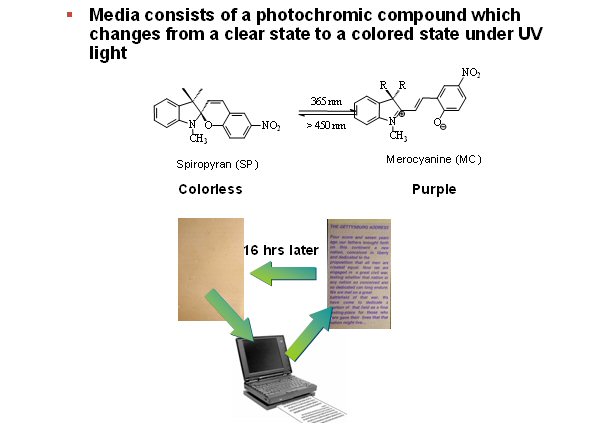
Graphic showing the "invisible ink" effect of the Xerox "photochromatic compound" transient document process. Image Credit: Xerox Corp.

At Xerox, It's Here Today ... Gone Tomorrow! - Originally posted 9/8/06

Just when you begin to think that paper documents are about to be a thing of the past ... "Everything is going digital!" ... Xerox reveals that it still is applying R&D assets on hardcopy processes.

That's right, there is an identified need to have a printed (on a sheet of paper) document that has a ticking-time value for its intended use. The image is applied to the paper, then, after about sixteen hours, the image disappears.

We at Symblogogy will define the document derived from this process as a "Workday Lifetime Document" or WLD.

Output from a Xerox inkless printer. Images last only about one working day. Image Credit: Xerox via TFOT

Excerpts from PC Pro (United Kingdom) -

Xerox reveals transient documents
By Alun Williams – PC Pro - Thursday 7th September 2006, 11:04 AM

Xerox has lifted the veil from some of its research and development work in the field of printing. The cutting-edge research highlighted at a press event involved current projects that are expected to see the commercial light of day within 18-months, including a twist on the theme of invisible ink.

Mario Jarmasz, an engineer from one of the company's R&D centres, in Grenoble, was speaking at the launch of the Xerox's entry-level A4-only multi-function printers. As well as a looking at 'print infrastructure mining', which brings the techniques of data mining to enterprise print logs to better optimise the flow of print jobs around an organisation, he also demoed the very intriguing 'transient documents'.

This offers the prospect of reusable paper in the sense that the content is automatically erased after a period of time, ready for fresh printing. Inspired by the fact that many print outs have a life-span of a few hours (think of the emails you may print out just to read, or the content you proof read on the train journey back home), the specially prepared paper will preserve its content for up to 16 hours.

XRCC researcher Peter Kazmaier with erasable paper output in the lab. Image Credit: Xerox via TFOT

The paper has a photochromic compound that changes from a clear state to a coloured state under ultra-violet light. This can create the print face, which will duly fade with time. Further research is being undertaken to give the option of subsequently preserving the content if the user desires, which might literally involve warming up old data through the heating of the paper.

----
Jarmasz also demonstrated the company's work on mobile document imaging, for example capturing data from business cards through a process of OCR compression and then transmission. Possible developments of this work include expanding email interfaces to incorporate handwritten input and the management of distributed forms.

Xerox, of course, is legendary for its Palo Alto Research Center (PARC), which claims credit for developing Ethernet and laser printers as well as the first personal computer. Having developed the machines, the researchers then wanted to connect them and then to print, and the rest is history.

Reference Here>>

Okay ... so, what do you think about this technological document imaging "breakthrough"? Symblogogy would like to hear your thoughts. The lines are open!



UPDATE - This, from interview posted at The Future Of Things 2-15-2007 -

To learn more about Xerox's inkless printer technology, an interview with Dr. Paul Smith, laboratory manager at the Xerox Research Centre of Canada, provides updated insights.

Q: When did you start working on the erasable paper technology and what was the motivation for the project?

A: We began work on erasable paper about three years ago. This followed extensive research by our work practices team from PARC who spent time with customers in offices. People still like the feel and look of paper—it is one of the best ways to communicate and show information. But our customers told us they would like to use a little less paper, so we began working on ways to create paper documents that could be reused.

Q: Did you have a Eureka! moment during the development?

A: The Eureka moment really came during the discussions with customers when we determined that two of every five documents are only used for as little as a day or even for less than a minute. Individuals might print their calendar or memos for a meeting or even the header sheet that goes with networked printers that tells who the document belongs to. You use that literally for only a minute and then put it in the recycle box.

Q: How does the erasable paper work? Could it be used to print in color?

Dr. Paul Smith with inkless output from two different runs. Image Credit: TFOT

A: The erasable paper is not really printed. The paper is coated with a coating of only a few microns. This overlay contains chemicals that are activated by a light bar in the printer or multifunction device that creates the image. At this time the image is black or a dark purple color. It is conceivable that color could be created, but we are not working in that area now.

Although on the surface it may appear simple to develop a paper that can be imaged using UV light alone and then fades at a specified rate at room temperature, in practice there are many complex elements which must come together to make this a viable technology. Erasable paper technology is based on a photochromic concept similar to transition sunglasses which turn dark in bright sunlight and are seen through in a dark room. In the case of sunglasses the photochromic molecule, normally from a class of molecules such as spiropyran, reversibly converts from a colorless form to a colored form. In the case of the erasable paper, the compound that is present within the paper also turns from a colorless form to colored when exposed to a specific wavelength of light. The compound then gradually reverts back to its original colorless form over a period of time.

The end result is a reusable paper which feels very much like regular paper and is not at all like the older, waxy fax paper. The reusable paper technology has been developed from scratch but does incorporate elements which have been disclosed before. With respect to the light source, it is just beyond the blue end of the visible light spectrum. The intensity required is directly related to the writing speed that one would like to support.


Q: Can we describe what you have developed as an inkless printer?

A: People normally associate printing with inks and toners which are deposited onto the paper to make the image. This in fact is an inkless printer. The media itself creates the image after exposure to light.

Q: How many write-rewrite cycles did you perform with each paper?

A: We have been able to rewrite on the paper as many as fifty times.

Q: What printing resolution did you achieve?

A: We currently use 150 dpi, but this is not a limitation, this is just due to the resolution of the image bar that we use. This resolution is more than adequate considering the documents that are being considered for use with transient documents such as cover sheets and e-mails. We could have a much higher resolution if required.

Q: Since the paper is sensitive to U.V. radiation, what happens if you leave paper near the window or even outside on a sunny day?

A: This paper responds to a specific wavelength of light and requires a certain intensity level to change color. The intensity required is higher than the intensity observed in sunlight.

Q: Many other technologies developed in the past by Xerox failed to materialize and were later introduced by other companies. Do you fear a similar fate for the erasable paper?


Xerox's erasable paper—gradual disappearance over time. Image Credit: Xerox via TFOT

A: It is sort of a Silicon Valley myth that Xerox has not been successful in bringing technology products to market, yet we are a $15.7 billion company based on technology that we created ourselves. Our researchers invented the Ethernet, the first laser printer, the first plain-paper fax machine and the graphic user interface. There have been more than 40 successful spin-outs and startups based on Xerox technology. We are confident, based on our extensive focus groups, that there is customer interest in this project and that we will be able to develop a successful product.

Q: Can the erasable paper be used for security purposes?
A: There are many potential applications and a large amount of interest for this technology. Xerox is currently considering all potential commercialization avenues.

Q: When do you predict the erasable paper to reach the consumer market, and what obstacles do you still face in its development?

A: This is a very early research project that is several years away from reaching the market. We will be looking at a number of elements related to quality of image, length of time for the image to fade and more. There is a great deal more work to be done before this will be a product.

Q: How much do you predict the erasable paper will cost when launched?

A: Because erasable paper is still in the research centers, there is no way to speculate on what the cost of the paper will be. However, I want to clarify that this may not require a stand-alone special printer. In our prototypes, we use it as an added feature in existing Xerox multifunction devices. The erasable paper would be in one of the three or four paper drawers that these devices typically offer.

Q: What are the current limitations of the erasable paper technology? Will you be able to control the time it takes for the text to disappear?

A: Currently the image fades in about 16 to 24 hours. We do expect further research will be able to control how long the image lasts. You can also immediately erase the paper and use it again by applying a heat source or putting the paper right in the machine to be reprinted.

Q: Do you fear people will mix regular paper and erasable paper and print important documents on erasable paper? Will it be possible to allow future printers to recognize the type of paper as erasable or regular and notify the user accordingly?

A: The way Xerox multifunction devices are set up, you can currently select what type of paper you wish to use, based on sizes, color, transparencies, and so forth that are loaded into the drawers. So it will certainly be an option that you will be able to tell the printing device when to use erasable paper.
Reference Here>>

UPDATED 5-2-2008:

Xerox touts erasable paper, smart documents
The hi-tech paper can be reused up to 100 times
By Agam Shah - April 29, 2008 (IDG News Service)

Xerox Corp.'s research arm yesterday showcased its latest innovations, including erasable paper and tools that make documents "smart" by adding a deeper meaning to words and images.

Since its establishment in 1970, the Palo Alto Research Center Inc. (PARC), funded by Xerox, has created numerous technologies now available on PCs, including Ethernet, the graphical user interface (GUI) and the computer mouse. The laboratory, with other Xerox research facilities, is now trying to help its parent company and other start-ups by focusing on printing and other innovations to access, use and secure electronic documents.

Scientists demonstrated paper that can be reused after printed text automatically deletes itself from the paper's surface within 24 hours. Instead of trashing or recycling after one use, a single piece of paper can be used a second time, and reused up to 100 times, said Eric Shrader, area manager at PARC.

Predictions that paper would disappear in the 1970s in favor of electronic documents were wrong, Shrader said. As the number of electronic documents produced increases, about two to five pages are printed in the office for daily use, like e-mail messages and Web pages, which are discarded or recycled after being read. Reusable paper reduces waste, is environmentally safe, and helps reduce overall printing and paper costs, Shrader said.

Reference Here>>

Friday, April 11, 2008

Racetrack – The Future Of Computer Memory Systems

Almaden Research Center - Image Credit: The Almaden Research Center (IBM)

Racetrack – The Future Of Computer Memory Systems

A new way and concept of looking at retrievable, stored memory has just been tested, proven and explained by IBM’s main research center in the Silicon Valley.

The Almaden Research Center announced this week the breakthrough in the way memory is stored and retrieved by using a system known internally as silicon-on-insulator photonic wire based racetrack resonators – “Racetrack” for short.

IBM's "RACETRACK" MEMORY MOVES CLOSER: A diagram of the nanowire shows how an electric current is used to slide -- or "race" – tiny magnetic patterns around the nanowire "track," where the device can read and write data in less than a nanosecond. The racetrack memory would stand billions of nanowires, like the one diagrammed here, around the edge of a chip, and potentially allow for hundreds of times the amount of storage in the same space as today's memory. Image Credit: The Almaden Research Center (IBM)

This excerpted from The Almaden Research Center (IBM) -

IBM Moves Closer to New Class of Computer Memory
The Almaden Research Center 10-Apr-2008

IBM scientists unveiled a major breakthrough in their effort to build a new class of memory, nicknamed "racetrack." The racetrack memory would stand billions of nanowires around the edge of a chip, and potentially allow for hundreds of times the amount of storage in the same space as today's memory.
----
In two papers published in the April 11 issue of Science, IBM Fellow Stuart Parkin and colleagues at the IBM Almaden Research Center in San Jose describe both the fundamentals of a technology dubbed "racetrack" memory as well as a milestone in that technology. This milestone could lead to electronic devices capable of storing far more data in the same amount of space than is possible today, with lightning-fast boot times, far lower cost and unprecedented stability and durability.
----

In their paper, the scientists describe their use of horizontal permalloy nanowires to demonstrate the successive creation, motion and detection of domain walls by using sequences of properly timed nanosecond long spin-polarized current pulses. The cycle time for the writing and shifting of the domain walls is a few tens of nanoseconds. These results illustrate the basic concept of a magnetic shift register relying on the phenomenon of spin momentum transfer to move series of closely spaced domain walls – an entirely new take on the decades-old concept of storing information in movable domain walls.

Ultimately, the researchers expect the racetrack to move into the third dimension (3D) with the construction of a novel 3D racetrack memory device, a paradigm shift from traditional two-dimensional arrays of transistors and magnetic bits found in silicon-based microelectronic devices and hard disk drives. By moving into the third dimension, racetrack memory stands to open new possibilities for developing less expensive, faster devices because it is not dependant on miniaturization as dictated by Moore’s Law.
----
The expected benefits of racetrack memory over today’s memory technologies include operating at a greater speed, consuming much less power, and being practically indestructible, potentially unleashing applications that nobody has even imagined yet.
Reference Here>>

Friday, April 04, 2008

Smartcard Hack Could Expose 2 Billion Cards

Embedded RFID MiFare Classic RFID chip. The ability to read and replace information stored on a card people carry to expidite transactions, access control, and other "secure" exchanges of sensitive information is at threat. Image Credit: CashCard

Smartcard Hack Could Expose 2 Billion Cards

A computer club in Germany in concert with a few university students in the United States have broken into the encryption scheme designed to secure the information stored on smartcards used in everyday applications.

These cards employ a RFID technology used in an estimated two billion plus smart cards first invented by NXP.

This event is the first real breach perpetrated on the widely used MiFare Classic RFID chip. The hackers, once they figured out how to break the encryption scheme, stated that the process is easy to reproduce. NXP downplays the significance of the hack.

Micromodule Pte Ltd is an independent smart card and micromodule manufacturer in Singapore. With complete module and smart card manufacturing facilities, we are offering very competitive, high quality chip cards and chip modules at fast delivery time. Our products include standard secure memory cards, microprocessor cards and custom specific multi-chip modules and cards (contact and contactless). We also supply all types of Mifare cards. Caption & Image Credit: Micromodule Pte Ltd

This excerpted from EETimes -

NXP RFID encryption cracked
Christoph Hammerschmidt - Industrial DesignLine Europe - (04/01/2008 8:11 AM EDT)

MUNICH, Germany — The Chaos Computer Club (Hamburg, Germany) has cracked the encryption scheme of NXPs popular Mifare Classic RFID chip. The device is used in many contactless smartcard applications including fare collection, loyalty cards or access control cards.
----
According to a report in Sueddeutsche Zeitung, Chaos Computer Club (CCC) experts along with colleagues from the University of Virginia cracked the encoding scheme with little effort. The achievement allows the crackers to read out data, recharge payment cards, copy RFID cards or generate "new" users.
----
The spokesperson also pointed out that the Mifare Classic is not used in security-critical applications such as passports or electronic health cards.

The Chaos Computer Club was not available for comment.

Reference Here>>

NXP MiFare RFID payment card – Image Credit: Arygon

And this excerpted from NXP about MiFare Classic –

The MIFARE® classic family is the pioneer and front runner in contactless smart card ICs operating in the 13.56 MHz frequency range with read/write capability. The MIFARE® standard IC, launched in 1995, was the first product which could be fitted into a ISO contactless smart card, and with its slim coil allowed very high volume production.

Today, over 200 million MIFARE® Standard ICs are in use around the globe, covering more than 85% (source: Frost & Sullivan, 2000) of the contactless smart card market. As such, MIFARE® Standard represents the de-facto industry standard and is the benchmark for competing technologies.

Reference Here>>

And lastly, this from Computerworld –

RFID hack could crack open 2 billion smart cards
Analyst: One European government sent armed guards to protect facilities using the card
By Sharon Gaudin - Computerworld - March 14, 2008

A student at the University of Virginia has discovered a way to break through the encryption code of RFID chips used in up to 2 billion smart cards used to open doors and board public transportation systems.
----
"It turns out it's a pretty huge deal," said Ken van Wyk, principal consultant at KRvW Associates. "There are a lot of these things floating around out there. Using it for building locks is the biggy, especially when it's used in sensitive government facilities — and I know for a fact it's being used in sensitive government facilities."

Van Wyk told Computerworld that one European country has deployed military soldiers to guard some government facilities that use the MiFare Classic chip in their smart door key cards. "Deploying guards to facilities like that is not done lightly," he added. "They recognize that they have a huge exposure. Deploying guards is expensive. They're not doing it because it's fun. They're safeguarding their systems." He declined to identify the European country.

Reference Here>>

If you are asking the layperson what he thinks about a security breach on a card (over 2 billion of them) that carries personal information and money information and that information can be changed without his knowledge – He will say, “That is a problem!”


Tuesday, April 01, 2008

TESCO’s USA Operations Go Live Fresh ... And Easy

TESCO's fresh & easy Logo - Image Credit: fresh & easy Neighborhood Market Inc.

TESCO’s USA Operations Go Live Fresh ... And Easy
(UPDATED April 1, 2008)

TESCO’s website that is a cornerstone for the ambitious effort to establish a new brand and way of convenience store positioning went live and online yesterday.

With this site, TESCO hopes to establish a communications link between its fledgling Fresh & Easy brand of neighborhood convenience food stores and labeled consumer products.

The site -- www.freshandeasy.com -- offers a background on the company, insight into its strategy and philosophy, and hints at what shoppers can expect from its stores. The company's purpose: "We're here to create value for our customers and earn their lifetime loyalty," states the information found at the site.

Further, with this first cornerstone of consumer communications launched, TESCO establishes that Fresh & Easy is more than just another website in support of a business operation … the website reflects the importance of a node of information that can be easily accessed and beyond just product promotion. It is important to note that the Fresh & Easy website is live before even one store is opened. It reflects a commitment to process and intent to become truly “Fresh & Easy”.

A Good Neighbor - Image Credit: fresh & easy Neighborhood Market Inc.

Excerpts from Convenience Store News -

Tesco Goes Online in U.S.
Progressive Grocer via Convenience Store News – April 18, 2007

EL SEGUNDO, Calif. -- Tesco's Fresh & Easy Neighborhood Market now has a Web site dedicated to providing consumers with company news and information about its stores, culture and philosophy, reported Progressive Grocer, sister company to Convenience Store News.
----
"It seems obvious. People want fresh, healthy food. People want things to be easy. So we're making our stores that way. How? By filling them with friendly people and high-quality food at affordable prices," the home page states. "Because we're a good neighbor who cares about the environment, we're including energy-efficient equipment in every store. And since we'll be right in the neighborhood, we'll help reduce our customers' travel time and boost local trade."

Along with a newsroom with current and past press information about the company, information on the site includes sections showcasing:

- The Fresh & Easy shopping experience and information on the Fresh & Easy line of products;

- The company's commitment to minimize its impact on the environment;

- The company's commitment to being a good neighbor;

- What it means to be a part of the Fresh & Easy Neighborhood Market team and details on the application process; and

- A "Your Thoughts" area, where consumers can provide feedback about the company or its stores.

Where We Are - Image Credit: fresh & easy Neighborhood Market Inc.

"As we prepare to open stores in neighborhoods throughout the West, we [want] to provide consumers with a tool to learn more about Fresh & Easy Neighborhood Market and the opportunities that will be coming into their communities later this year," said Fresh & Easy CEO Tim Mason.
----
As planned stores open in Los Angeles, San Diego, Phoenix and Las Vegas, specific store locations and details will also be available on the site, the report stated.

Tesco CEO Terry Leahy said earlier this week that he is "increasingly encouraged" by the prospects for success in the U.S. with the new format. Leahy told Reuters the company's startup costs for the U.S. operation were around 65 million pounds ($129 million). He also said he anticipates the U.S. business to be profitable in its third year.

The chain also reported a record 2.55 billion pounds ($5.1 billion) in annual profit, and doubled the amount of its cash dividend to shareholders, Progressive Grocer reported.
Read All>>

The only application left that would really complete the "fresh & easy" information circle would be to launch a compatible Physical World Hyperlink symbology strategy that would direct cellphone users to the information on their site.


UPDATE - June 21, 2007:

TESCO fresh&easy Store Design Concept - We've tried to come up with a distinctive and attractive building which would be a welcome addition to any neighborhood, create the right environment for a fresh&easy shopping trip, but also be much more energy-efficient than a standard store. Hopefully, we've managed to achieve all three. Image Credit: fresh&easy blog

This from a news conference with TESCO in San Diego:

Tesco's Fresh & Easy Reveals San Diego Plans
Store locations and consumer research discussed at press conference.
Convenience Store News Daily - June 21, 2007

SAN DIEGO -- Tesco unveiled seven locations for San Diego-area Fresh & Easy Neighborhood Market stores here yesterday, in addition to details of its research into the consumer market.

The seven sites in the San Diego-area have already been secured and additional locations are being researched, the company stated. The San Diego-area locations include:

• Campo & Kenwood, Casa de Oro
• Catalina & Cannon, Point Loma
• East Vista & Vale Terrace, Vista
• East H & Tierra Del Ray, Chula Vista
• Lake Murray & Navajo, San Diego
• Main & Ammunition, Fallbrook
• Valley & Ash, Escondido
[graphic update below]

This is the third announcement the company has made concerning its locations. Other cities where locations have been revealed include Las Vegas and Phoenix. In addition to these areas, the company will open Fresh & Easy stores throughout Southern California.

“San Diego is filled with vibrant neighborhoods and residents who understand the value of nature’s gifts, from stunning beaches to delicious fruits and vegetables," said Tim Mason, Fresh & Easy Neighborhood Market CEO. "We think our stores’ approach to bringing fresh, high quality foods to the neighborhood will be a hit with San Diego consumers."

The Fresh & Easy Neighborhood Market format is based on extensive customer research in local U.S. markets, along with the learnings from Tesco’s Express format, which it operates more than 1,000 stores in seven countries. For the U.S. launch, Fresh & Easy researchers spent time in the homes of consumers looking at shopping and cooking patterns.

“We literally went into their kitchens and looked in their refrigerators,” said Mason. “Based on our research, we are confident our stores will be a hit in every neighborhood we open in.”

In addition, the company’s research showed it could reach Hispanic consumers by offering a mix of authentic and national brand products that households use, together with low prices, quality meat and produce and a clean store environment, the company stated.
Reference Here>>

Tesco's effort here in the United States is really becoming a case study in drafting and deploying business plans that have a look of success.

One may deride the Tesco effort as having unlimited resources in which to build winning plans but the point still remains ... it is easier to create plans and fail than it is to implement a winning strategy. fresh & easy has the look of a winning strategy.

Area Locations Graphics As Of August 6, 2007:


Los Angeles, CA Area Locations

Los Angeles, CA Area Locations - Graphic Credit: fresh & easy Neighborhood Market Inc.


San Diego, CA Area Locations

San Diego, CA Area Locations - Graphic Credit: fresh & easy Neighborhood Market Inc.


Las Vegas, NV Area Locations

Las Vegas, NV Area Locations - Graphic Credit: fresh & easy Neighborhood Market Inc.


Phoenix, AZ Area Locations

Phoenix, AZ Area Locations - Graphic Credit: fresh & easy Neighborhood Market Inc.


UPDATE: April 1, 2008


Fresh & Easy - "Hollywood, We're Ready For Our Close-Up!" - Tesco's F&E location about 2 blocks west of Highland Avenue on the North side of Hollywood Blvd. just before the store opening on January 23, 2008. Image Credit Edmund Jenks (MAXINE) - 2008

NOT an April Fool - This from Thompson Financial -

Tesco takes three-month breather on US expansion plans

By Kathy Sandler - Thomson Financial | 03.30.08, 2:36 PM ET

LONDON - Tesco PLC has called a three-month hiatus on its US expansion programme to 'kick the tyres' and smooth out the wrinkles following the opening of its first 59 Fresh & Easy stores.

Writing on his internet blog, marketing director for the Fresh & Easy business Simon Uwins said the company will take a three-month break from openings to allow the business to settle down.

The next 3 months will allow us to accelerate this process, before we restart what's been described as an opening programme on steroids,' he said.

Reference Here>>
(ht: Forbes)

Wednesday, March 26, 2008

Motorola Not Ebony And Ivory (Harmony)

Motorola Solutions Fit Every Segment - Image Credit: Motorola.com

Motorola Not Ebony And Ivory (Harmony)

Enterprise mobility, and the solutions they provide are not necessarily compatible across the need level ecosystem, at least according to Motorola management.

About eighteen months ago, Motorola felt that purchasing a mobility Auto ID company, like industry leader Symbol Technologies, would bring along a synergy to their business model that few cellphone/radio communications companies in the world would have. Most analysts agreed to the proposition that the small form factor manufacturing commonality, combined with the different and unique focus in non-conflicting markets could be a strong asset going forward.

If this concept was ever true, Motorola blew it. If the concept wasn’t true, a lot of the misunderstanding to corporate culture in niche markets and the ability to remain relevant in an evolving WEB 2.0 world may have been the culprits.

Motorola handsets to be made a stand alone business unit. Image Credit: Motorola.com

This excerpted from CNET -

Motorola hits redial on handset biz
Posted by
Marguerite Reardon, CNET News.com March 26, 2008 7:37 AM PDT

Motorola is hoping two is better than one.

On Wednesday, the company, whose
cell phone business has been in a death spiral for several quarters, announced that after a two-month formal analysis, it has decided to split the company into two publicly traded entities.

One will handle handsets and accessories while the other will continue to concentrate on wireless broadband and enterprise communication products.

"Creating two industry-leading companies will provide improved flexibility, more tailored capital structures, and increased management focus--as well as more targeted investment opportunities for our shareholders," CEO Greg Brown said in a release.

The Mobile Devices business will handle the designs, manufacturing, and sales of mobile handsets and accessories, and will license a portfolio of intellectual property.

The Broadband & Mobility Solutions business will handle service voice and data communication solutions and wireless broadband networks for enterprises and governments. It will also handle IP video, cellular, and high-speed broadband network infrastructure, and cable set-top receivers.

Investor Carl Icahn has been pressuring the company to
separate out its mobile phone business, and has been engaged in a protracted legal struggle with the company regarding its future. Motorola offered up two board seats to Icahn this week, but the activist investor rejected the offer. Brown declined to comment on how this latest news will impact discussions with Icahn's camp.
----
But many questions linger. For one, how will spinning off the business unit actually help the company get back on track? And then there is the question of brand. Motorola has an 80-year history as a communications provider. The company practically invented the cell phone industry in the 1980s. So what will it do with a brand it has spent billions of dollars and decades creating?

Brown gave vague answers to these questions during the conference call. He reasoned that splitting Motorola into two separate companies will allow management teams to focus and tailor their financials to the needs of those businesses.
----
But even though it's easy to see how Motorola's other businesses might benefit from the separation, it's still a bit unclear what will really be different in the handset division. The company's problem is that it isn't making products people want to buy.
----
Brown acknowledged that new products are key to turning around the handset business. But he said the division needs to be separated to help attract new, top-level talent to lead the recovery. Brown is currently searching for a new CEO to head up the new company.
----
"The Motorola brand is strong and trusted and proven," he said. "It's valuable to mobile devices as well as other assets in parts of the business. We will refine the brand strategy in next several months going forward."

But Forrester's Daley believes that keeping the brand with the handset division really is the only viable option the company has.

"Good or bad--Motorola's brand is for mobile devices," she said. "The broadband and mobility solutions unit will have to grow and separate their brand/value from the consumer-device company."
Reference Here>>

So the name change from Symbol Technologies to Motorola really hasn’t helped ... Symbol Technologies already had great brand/value as an enterprise mobility solutions provider and NOW it has lost its "good" name - in only 14 months after Motorola's purchase.

Motorola enterprize mobility solutions (Symbol Technologies) to be made a stand alone business unit after only 14 months. Image Credit: Motorola.com

And this view excerpted from InfoWorld –

Update: Motorola to split in two
Reorganization mirrors moves Nokia, Ericsson have made
By Mikael Ricknäs, IDG News Service / InfoWorld March 26, 2008

"Everyone agrees Motorola had to do something, the split will relieve some of the pressure from stockholders," said Ben Wood, director of research at CCS Insight, who at first glance thinks the split makes sense.
----
"The mobile phone division has taken a bit of a beating, and this is what you get," said Richard Webb, directing analyst, WiMax, Wi-Fi, and Mobile Devices at Infonetics Research.

The split will provide improved flexibility, more tailored capital structures, and increased management focus -- as well as more targeted investment opportunities for shareholders, according to Greg Brown, Motorola's president and chief executive officer.

Analysts agree the split will bring improved focus, especially for the mobile phone company.

"[The mobile phone part] won't have to take the infrastructure side into consideration, and the split may also help raise its profile," said Webb.

But that can also be a bad thing. It was in part because of handsets that Sprint dared to make its big gamble on WiMax, which has proved problematic.
In the end, the mobile phone business needs a healthy and competitive Motorola, according to Wood.

"It's needed to provide some balance with Nokia. A Nokia-Samsung duopoly isn't good for anyone," he said.
Reference Here>>

Monday, March 24, 2008

Biometrics For The Greater Good | UPDATED

Pay By Touch at The FMI Show + Marketechnics 2007 - McCormick Place West Expansion, Chicago, Illinois. Image Credit: ecj - Symblogogy - Copyright 2007

Biometrics For The Greater Good
Pay By Touch ID Delivers Discounts, Rewards Recognition, Credit, & More

(UPDATED At Bottom)

Consumer services has become a pretty arduous process over the years.

In order for the average consumer to take advantage of the systems and processes that support loyal and local shopping, one had to scan the local paper for coupons and clip them, carry a host of store issued loyalty verification instruments (key fobs, cards, “speedpass” RFID tags, & etc.), then get out and shop … Oh! … and don’t forget the wallet.

Wouldn’t it be nice to be recognized as if all of the stores knew every shopper by name, you know ... as if one were living in an idealized small town in “RFD” America?

One would leave the house with a list of things to buy and that’s it! No coupons and the time invested to collect them, no store cards through which one qualifies for an additional discount off of the purchase, and no wallet to carry cash and credit card by which to pay for the items one needed.

This world view scenario is available here and now and it is a world envisioned by Pay By Touch that utilizes fingerprint biometrics for the greater good!

SmartShop Express station aids in converting customers to the benefits of the Pay By Touch process. Image Credit: ecj - Symblogogy - Copyright 2007

Excerpts from the Pay By Touch website and press releases –

Pay By Touch ID Delivers Discounts, Rewards Recognition, Credit, & More
Compiled & Edited by Symblogogy

Pay By Touch is the leading biometric authentication network for loyalty and payments, and the only company that integrates biometric authentication, payments, personalized marketing, and payment processing. The company's mission is to liberate consumers through biometrics and beyond by providing the most secure, convenient, and cost-effective electronic transaction solutions available.

Pay By Touch is a free service that allows you to pay for purchases and access loyalty discounts simply by placing your finger on a sensor when you check out. Your finger links you, and only you, to your accounts – completely eliminating the need to carry cards, checks or cash.

it's safe
Your finger is unique to you, which means only you can access your financial accounts. The Pay By Touch service helps protect you from physical or identity theft. Because there’s nothing to carry, there’s nothing to be lost or stolen.

it's fast and easy
Enroll once and use it anywhere! No writing checks. No cards to swipe. No fumbling with cash. No need to show your ID.

it's private
Because you don’t have to present your cards, check or ID when you pay, no one can see your account information. Your information is securely stored and will not be sold to third parties.

it's free
The Pay By Touch service is always free and there are no hidden fees.

... automatic rewards
Free yourself from all those rewards cards and keyfobs. Your savings and rewards are automatically applied when you check out.
----


Pay By Touch SmartShop Express In-Store Coupon Claiming Demo - Video Credit: ecj - Symblogogy - Copyright 2007

SmartShop™ Service Alliance Announcement Press Release -

Biometric Pioneer’s Personalized Marketing Service Delivers the Right Offer to the Right Shopper at the Right Time
Shop n’ Save, Foodtown and Leading Consumer Packaged Goods Manufacturers are Among Early Adopters

2007 FMI SHOW+MARKETECHNICS & SAN FRANCISCO, CA – (May 7, 2007)


To facilitate rapid consumer adoption and give merchants maximum flexibility, Pay By Touch has added a card-based option to its biometric SmartShop™ service. SmartShop, powered by Pay By Touch, gives shoppers customized offers on the products they buy most when they enter the store – before they shop.

Pay By Touch, the leader in biometric payment and personalized marketing, is offering card-based SmartShop in addition to the biometric SmartShop service, which launched at NRF in January, 2007. SmartShop provides merchants and consumer packaged goods companies (CPGs) with an unprecedented return on investment (ROI) by enabling them to deliver the right offer to the right shopper at the right time – both in-store and online.

John Costello, President, Consumer and Retail - "At Pay By Touch, we understand that each retailer is unique. Card-based SmartShop enables merchants to immediately engage their best shoppers by letting them use their existing loyalty cards to get personalized offers,” said John Rogers, Founder, Chairman and CEO, Pay By Touch. “SmartShop offers unparalleled, automated targeting based on preferences in each particular store. There is no better way for merchants and manufacturers to reach their targets." - Image Credit: ecj - Symblogogy - Copyright 2007

Research shows that 70 percent of buying decisions are made in-store, and that less than one percent of grocery store coupons are ever redeemed . As a result, millions of marketing dollars are wasted every year. SmartShop turns every shopper into a uniquely qualified marketing lead and delivers value to consumers, merchants and manufacturers alike.

SmartShop enhances retailers’ existing loyalty programs by delivering added value to their most important customers. It also provides a robust loyalty solution for retailers who do not yet have a program in place. Best of all, SmartShop ‘learns’ from each shopping trip to generate the next set of relevant rewards.
----
Card-based SmartShop has been implemented by Shop ‘n Save stores in the Pittsburgh, Pennsylvania area, as well as Foodtown stores in New York and New Jersey. These merchants will migrate to biometric SmartShop, and adopt Pay By Touch’s biometric payment solution, to let shoppers identify themselves, pay for purchases and redeem rewards with the simple touch of a finger.

“We are extremely pleased with the SmartShop service, which is branded ‘Shop ‘n Save Personalized Perks’ in three of our Pittsburgh-area stores,” said Greg Hartley, Owner of three Shop 'n Save locations. “The service is a huge hit with our shoppers, with kiosks in each store receiving more than 300 visits a day. We are excited to continue using the program and we are looking forward to seeing the kiosk in other Shop 'n Save stores."

Early results reveal the value of the SmartShop service. These merchants can experience:

•Twenty to 50 percent shopper adoption of SmartShop

•Eight to 12 percent sales lift among customers using SmartShop

•A 25 to 30 percent reduction in advertising and direct mail printing and distribution costs

SC Johnson Among Early CPG Adopters

Already, several leading CPGs have joined the program, including SC Johnson and more. These companies are leveraging the SmartShop platform to deliver personalized, highly relevant coupons and deepen their relationships with consumers. With SmartShop, CPGs can experience:
•Twenty percent+ sales lift

•Four to five times greater redemption rates than traditional FSIs

•Twenty to 50 percent reduction in marketing costs per unit sold at retail

•A significant reduction in handling costs

How SmartShop Works:

1.) When shoppers enter the store, they simply scan their loyalty card at the SmartShop kiosk to get personalized offers based on their purchase history.

2.) Shoppers receive an 8 ½ x 11 print-out with 16 customized offers on the products they buy most, and then head into the aisles to shop.

3.) Shoppers scan their loyalty card at check-out to redeem their offers. They do not need to bring the print-out to check-out; no paper coupons are required.

SmartShop gives merchants customer-based metrics and accurate data that improves the efficacy of marketing efforts. It is easy to implement, with a Web-based management system for algorithmic campaign creation and real-time targeting. The service provides robust analytics to make reporting and account settlement both easy and accurate.
Reference Here>>

UPDATE - March 24, 2008

Pay By Touch Shuts Down Tranaction Processing ... Goes Out Of Business

After filing for Chapter Eleven debt restructuring in December of 2007, the hope was that Pay By Touch would be able to continue its business of biometric identification aided transaction processing for is portfolio of strong and happy clients.

Sadly, today PBT shuts down its ability to care for its customers.

This excerpted from the Progressive Grocer -

Pay By Touch Shuts Down all Biometrics
Progressive Grocer - March 24, 2008

Solidus Networks, Inc., the San Francisco-based biometric solutions company that did business as Pay By Touch, ceased processing biometric transactions on behalf of its retailer customers and consumer membership last week, a move it said was due to "lack of funding and current market conditions."

Pay By Touch's biometric payment systems were being used by dozens of retailers, including Pathmark, Piggly Wiggly, Jewel-Osco and Cub Foods. Last year it released its Smart Shop offering, first developed and piloted at independent grocer Green Hills, and then later launched at high-profile independent Dorothy Lane Markets.

On December 14, 2007, Solidus had filed for Chapter 11 bankruptcy protection. Solidus said as part of its planned restructuring it determined it could no longer support the biometric authentication and payment system. Other non-biometric Solidus Networks business units will continue operating, it said.

The company's move to pull the rug out from under the program came as a surprise to some, considering the successful track record it apparently with retailers.

At Dayton, Ohio-based Dorothy Lane, the Smart Shop loyalty and payment service was used in transactions totaling 24 percent of sales, just two weeks after it launched in July.
----
Meanwhile, Pay By Touch's Web site currently displays just one active page, with a statement from the company that reads in part: "Solidus Networks extends its sincere gratitude to the shoppers, merchants, vendors, investors, partners, and employees who have been supporting the company's vision since its first biometric payment transaction in 2002."

Observers commenting on a story that ran on the Web site of The Wall Street Journal about the demise Pay By Touch suggested that the business, not the technology, was the problem.

"I'm an ex-employee, and despite the eventual demise of the company, there were some interesting things learned about mainstream biometrics for the consumer," noted one online poster.

"None of the management of the company had any notion of businesses that wage world class technology competitions, as did the famous Silicon Valley successes," commented another. "The management all came from a so-called 'solution' business, where technology is secondary and services are the identity. Contrary to belief, the biometric technology was not designed in house. They really had nothing to compete with. So the company had no identity and was doomed to failure from the outset."

Reference Here>>

At Symblogogy, we believe that a biometric pay paradigm as pioneered by Pay By Touch for retail and other type of transactions is not dead ... just in delay.


Thursday, March 20, 2008

Peace Symbol Turns 50!

Before barcodes, RFID, Magnetic Stripe and other encoding technologies, there was Semaphore. The peace symbol was born from the flag positions that represent the letters “N” and “D” used to communicate nuclear disarmament. Gerald Holtom, a graphic designer who figured that the British anti-nuke movement would gain more traction if it had a logo, settled on this final approach and the symbol was developed. Image Credit: Campaign for Nuclear Disarmament via BBC NEWS

Peace Symbol Turns 50!

That's right, one of the most recognizable symbols of this modern era ... almost as recognizable as the yellow "Happy Face" ... turns fifty years old today.

Symblogogy generally focuses on processes that help to automate our lives. Most postings have evolved through developments in automatic identification, and the systems that aid solution delivery and communication.

Peace Symbol Buttons - Image Credit: jnhkrawczyk

The Peace Symbol, however, needs to be noted because of its recognizability and awareness impact.

This excerpted from BBC NEWS -

World's best-known protest symbol turns 50
By Kathryn Westcott, BBC NEWS – Last Updated: Thursday, 20 March 2008, 10:49 GMT

It started life as the emblem of the British anti-nuclear movement but it has become an international sign for peace, and arguably the most widely used protest symbol in the world. It has also been adapted, attacked and commercialised.

Good Friday march for disarmament to Aldermaston. Image Credit: BBC NEWS

It had its first public outing 50 years ago on a chilly Good Friday as thousands of British anti-nuclear campaigners set off from London's Trafalgar Square on a 50-mile march to the weapons factory at Aldermaston.

The demonstration had been organised by the Direct Action Committee Against Nuclear War (DAC) and the Campaign for Nuclear Disarmament (CND) joined in.

Gerald Holtom, a designer and former World War II conscientious objector from West London, persuaded DAC that their aims would have greater impact if they were conveyed in a visual image. The "Ban the Bomb" symbol was born.
----
Holtom later explained that the design was "to mean a human being in despair" with arms outstretched downwards.

Reference Here>>

Some mistakenly think the three-pointed star symbol of Mercedes-Benz logo as the Peace Symbol ... this, of course, is not the case.


Sunday, March 09, 2008

Get On The Stick! ... With Cuba’s IT Underground

Having a USB memory stick is like carrying a portable hard drive the size of a packet of chewing gum. USB memory sticks are the fastest in the flash memory card industry with transfer rates up to 60MB/s and capacities ranging from 64MB to 4GB. Caption & Image Credit: mediaheaven.co.uk

Get On The Stick! ... With Cuba’s IT Underground

Necessity is the mother of invention – or in this case adaptation. Information technology in Cuba, with its heavy-handed oversight of human activity, is in a process of breaking out of the grip of the government sanctions against the freedom of information sharing and publishing.

News, information, and entertainment media in Cuba, is hard to come by unless one is able to afford the time to log on to a computer in one of the few “Cyber Cafés”, have access to a tourist hotel internet portal, is a student, or has access to a smuggled dish and secretly grab the information for later viewing and sharing - OFFLINE!

Dutch made , USB Memory sticks manually selected for their natural beauty, and professionally handmade into unique and personal USB memory sticks. From ooms. Order Online - 256 MB - 45 Euro 1GB - 70 Euro. Caption & Image Credit: oooms.nl

OFFLINE in Cuba is an intranet (an in-country internet) patched together through a “postal service” email communication connection that the government is having trouble shutting down. The “Whack-A-Mole” process the government is left with can not stop the viral sharing aided with the use of USB memory sticks.

At an e-mail center in Havana, customers work under an employee’s watchful eye. Old Havana has only one true Internet cafe, down from three a few years ago. Caption & Image Credit: Jose Goitia - The New York Times

This excerpted from The New York Times -

Cyber-Rebels in Cuba Defy State’s Limits
By JAMES C. McKINLEY Jr. - New York Times, HAVANA - March 6, 2008

A growing underground network of young people armed with computer memory sticks, digital cameras and clandestine Internet hookups has been mounting some challenges to the Cuban government in recent months, spreading news that the official state media try to suppress.

Last month, students at a prestigious computer science university videotaped an ugly confrontation they had with Ricardo Alarcón, the president of the National Assembly.

Mr. Alarcón seemed flummoxed when students grilled him on why they could not travel abroad, stay at hotels, earn better wages or use search engines like Google. The video spread like wildfire through Havana, passed from person to person, and seriously damaged Mr. Alarcón’s reputation in some circles.
----
“It passes from flash drive to flash drive,” said Ariel, 33, a computer programmer, who, like almost everyone else interviewed for this article, asked that his last name not be used for fear of political persecution. “This is going to get out of the government’s hands because the technology is moving so rapidly.”

Cuban officials have long limited the public’s access to the Internet and digital videos, tearing down unauthorized satellite dishes and keeping down the number of Internet cafes open to Cubans. Only one Internet cafe remains open in Old Havana, down from three a few years ago.

Hidden in a small room in the depths of the Capitol building, the state-owned cafe charges a third of the average Cuban’s monthly salary — about $5 — to use a computer for an hour. The other two former Internet cafes in central Havana have been converted into “postal services” that let Cubans send e-mail messages over a closed network on the island with no links to the Internet.
----
Young people here say there is a thriving black market giving thousands of people an underground connection to the world outside the Communist country.


Swiss army knife with USB memory stick Memory size: 128MB 256MB 512MB 1GB 2GB 4GB 8GB. Caption & Image Credit: sz-wholesale.com

People who have smuggled in satellite dishes provide illegal connections to the Internet for a fee or download movies to sell on discs. Others exploit the connections to the Web of foreign businesses and state-run enterprises. Employees with the ability to connect to the Internet often sell their passwords and identification numbers for use in the middle of the night.

Hotels catering to tourists provide Internet services, and Cubans also exploit those conduits to the Web.

Even the country’s top computer science school, the University of Information Sciences, set in a campus once used by Cuba’s spy services, has become a hotbed of cyber-rebels. Students download everything from the latest American television shows to articles and videos criticizing the government, and pass them quickly around the island.
----
The video of Mr. Alarcón’s clash with students was leaked to the BBC and CNN, giving the world a rare glimpse of the discontent among the young with the system.
----
Another event many people witnessed through the digital underground was the arrival in the United States of Carlos Otero, a popular television personality and humorist in Cuba who defected in December while on a trip to Toronto.

Illegal antennas caught signals from Miami television stations, which youths turned into digital videos and shared. Though the event smacked more of celebrity news than politics, it would never have been shown on the official media.

Some young journalists have also started blogs and Internet news sites, using servers in other countries, and their reports are reaching people through the digital underground.

Yoani Sánchez, 32, and her husband, Reinaldo Escobar, 60, established Consenso desde Cuba , a Web site based in Germany. Ms. Sánchez has attracted a considerable following with her blog, Generación Y, in which she has artfully written gentle critiques of the government by describing her daily life in Cuba. Ms. Sánchez and her husband said they believed strongly in using their names with articles despite the possible political repercussions.


Shortly before Raúl Castro was elected president last week to replace his ailing brother, Fidel, Ms. Sánchez wrote a piece describing what sort of president she wanted. She said the country did not need a soldier, a charismatic leader or a great speaker, but “a pragmatic housewife” who favored freedom of speech and open elections.

Writing later about Raúl Castro’s first speech as president, she criticized his vague promises of change, saying they were as clear as the Rosetta Stone was when it was first found. Both essays would be impossible to publish in Cuba.
----
Because Ms. Sánchez, like most Cubans, can get online for only a few minutes at a time, she writes almost all her essays beforehand, then goes to the one Internet cafe, signs on, updates her Web site, copies some key pages that interest her and walks out with everything on a memory stick. Friends copy the information, and it passes from hand to hand. “It’s a solid underground,” she said. “The government cannot control the information.”

It is spread by readers like Ricardo, 28, a philosophy student at the University of Havana who sells memory sticks to other students.
----
Like many young Cubans, Ricardo plays a game of cat and mouse with the authorities. He doubts that the government will ever let ordinary citizens have access to the Internet in their homes. “That’s far too dangerous,” he said. “Daddy State doesn’t want you to get informed, so it preventively keeps you from surfing.”

Pedro, a midlevel official with a government agency, said he often surfed Web sites like the BBC and The Miami Herald at work, searching for another view of the news besides the ones presented in the state-controlled media. He predicted that the 10,000 students studying the Internet and programming at the University of Information Sciences would transform the country over time, opening up more and more avenues of information.

“We are training an army of information specialists,” he said.

Reference Here>>

Saturday, February 23, 2008

Short Range Proximity Communications Breakthrough

GiFi (60GHz "millimetre wave" spectrum wireless communications) may have a function effect on all consumer and appliance electronics. Image Credit: bargaindealsonline.com

Short Range Proximity Communications Breakthrough

Short-range wireless technology is a hotly contested area for technology development. Many research teams around the world are racing to be the first to make and have embedded into small display devices, proximity technology that would deliver the capability to transfer a high volume of data at high-speed.

The assumption is that every display device (TV, cellphone, PDA, computer, portable game handset) would benefit from having the ability to be within 30 to 40 feet from a transmission source and be able to display high quality video images.

Applications range from having an information kiosk right in ones hand to high density/high speed data transfers from handset to computer or computer to TV and any combination therein.

Japan's NEC Corp unveiled a prototype cellphone handset capable of receiving digital broadcasting signals, enabling users to not only make calls and take photos, but to watch TV. Image Credit: WebTechGeek.com

Examples: One goes to a movie retailer, and 1) samples a movie from a kiosk via the cellphone display, decides to 2) purchase the movie for viewing later on ones home entertainment system – on the way home, one walks up to a transit terminal and 3) finds the best bus route to make it back home and 4) purchases the fare. At home, the movie is 5) transmitted and transferred to the computer or the home entertainment system for viewing.

This string of functionality can be made possible without a camera/scanner and is compatible to be embedded via a small computer chip that can be placed on circuit boards of any consumer appliance or device which would make them “GiFi” capable (60GHz "millimetre wave" spectrum wireless communications). Wireless, high speed, anywhere, anytime, any device, within 30 to 40 feet proximity … and nearly free – now that is a revolution in short range communicative power.

GiFi chips are smaller and more powerful than Bluetooth. GPS Chips -The smallest chip is the newest GPS chip from SiRF, the middle one includes a Bluetooth connection (for a wireless connection with other devices that can use GPS coordinates), the top one is last year’s GPS chip. Image Credit: Tarmo Virki

This excerpted from Fairfax Digital’s, The Age -

$10 chip puts Australia on the fast track
Nick Miller - The Age - February 22, 2008 - 1:18PM

A new silicon chip developed in Melbourne is predicted to revolutionise the way household gadgets like televisions, phones and DVD players talk to each other.

The tiny five-millimetre-a-side chip can transmit data through a wireless connection at a breakthrough five gigabits per second over distances of up to 10 metres.
----
The "GiFi" was unveiled today at the Melbourne University-based laboratories of NICTA, the national information and communications technology research centre.

Professor Stan Skafidis of Melbourne University. Image Credit: Neil Newitt

"I believe in the longer term every consumer device will have this technology," said project leader, Professor Stan Skafidas, who with his team spent almost a decade developing the chip.
----
Professor Skafidas said his team is the first to demonstrate a working transceiver-on-a-chip that uses CMOS (complementary metal-oxide-semiconductor) technology - the cheap, ubiquitous technique that prints silicon chips.

This means his team is head and shoulders in front of the competition in terms of price and power demand. His chip uses only a tiny one-millimetre-wide antenna and less than two watts of power, and would cost less than $10 to manufacture.

It uses the 60GHz "millimetre wave" spectrum to transmit the data, which gives it an advantage over WiFi (wireless internet). WiFi's part of the spectrum is increasingly crowded, sharing the waves with devices such as cordless phones, which leads to interference and slower speeds.

But the millimetre wave spectrum (30 to 300 GHz) is almost unoccupied, and the new chip is potentially hundreds of times faster than the average home WiFi unit. However, WiFi still benefits from being able to provide wireless coverage over a greater distance.
----
For Professor Skafidas, the chip is several breakthroughs in one. It includes a world-first power amplifier that is only a few microns wide, with a micron being one 300th the width of a human hair.

It also has world's first signal mixing and filter technology, and a switch that isolates the transmitter and receiver so they do not interfere with each other.
There is about another year's worth of work on the chip before it is ready to be marketed to the public, he said, and the team still needs to develop technology that injects data into the transceiver.

Professor Skafidas said he sees several ways the technology could be put to use.
It could be used to transfer data-rich content such as video around the home between different storage and display devices, and it could help turn a mobile device into a "shopping cart" for data.

A mobile device could also become a fully-fledged computer through the GiFi, simply by placing it near similarly-equipped peripherals such as a screen, extra storage, optical drives, a keyboard and mouse.
Reference Here>>