Showing posts with label ColorZip. Show all posts

Friday, August 03, 2007

Faceprints As Symbology

University researchers developed the URxD face recognition software that uses a three-dimensional snapshot of a person's face to create a unique biometric identifier. Image Credit: University of Houston via NetworkWorld

Faceprints As Symbology

Who needs a number when you have a face? That’s what we say here at Symblogogy!

Symbologies such as barcodes are rapidly being replaced by other pattern identifiers found through digital conversion.

As noted here a few months ago, ColorCode/ColorZip created a new type of symbology to be used for advertisers that takes a picture of an Ad an and converts it to a type of QR Code based symbology. The purpose here would allow the user access to additional information by taking a photograph with ones phone on the product Ad and digital image converted.

Here in Houston, they have created a different approach to digital conversion and identification. A webcam captures a continuous video stream which is used to detect the face of an individual and converts the images captured to a unique identifier … just like a barcode on a keyfob.

It will only be a matter of time when one can step up in line at the supermarket and have ones loyalty points automatically accrue and discounts awarded through photographic digital conversion as symbology access to database information capture and update.

This from NetworkWorld -

Forget your PIN? Use your face
Submitted by
Layer 8 on Wed, 08/01/2007 - 11:49am.

Face recognition as a unique biometric is growing slowly in certain corporate and consumer applications, but researchers at the University of Houston (UH) are trying to make the technology far more ubiquitous and secure: they want it to replace the dozens of personal identification numbers (PIN), passwords and credit card numbers everyone uses every day.

The UH designed and built a prototype field-deployable 3D face recognition system that consists of a 3dMDTM optical scanner using a 1-pod configuration, which is connected to a PC.
----
When the subject is facing the camera and remains relatively still for more than two seconds, the system triggers the optical scanner and the 3D data of the individual's face are captured. The system can either enroll the subject into the database, or perform a scenario-specific task. In an identification scenario, the system will display the closest 5 datasets to the operator. In a verification scenario, the system will determine whether the subject is who they claim to be, based on a preset distance threshold, UH says.
The system determines not only the characteristics of each face, but also whether the person is wearing glasses, allowing for a practical system which offers high accuracy. So far, face recognition methods have focused on appearance - capturing, representing, and matching facial characteristics as they appear on two-dimensional images in the visible spectrum. This is quite challenging to machine recognition because such characteristics vary with orientation, age, habits (beard etc)), and illumination. Instead, the UH system uses three-dimensional information.

The system was highly rated by The National Institute of Standards and Technology (NIST) in its annual Face Recognition Vendor Test (FRVT) 2006 and the Iris Challenge Evaluation (ICE) 2006. NIST said the FRVT looks at face recognition from high-resolution still images and three-dimensional (3D) face images, and measures performance for still images taken under controlled and uncontrolled illumination. Face and iris are two biometrics that have been developed over the last 20 years. Face recognition is a vibrant area of biometrics with active research and commercial efforts.
----
"Remembering dozens of personal identification numbers and passwords is not the solution to identity theft. PINs and passwords are not only inconvenient to memorize, but also are impractical to safeguard. In essence, they merely tie two pieces of information together; once the secret is compromised, the rest follows. The solution is to be able to tie your private information to your person in a way that cannot be compromised," said Eckhard Pfeiffer Professor of Computer Science and director of the UH Computational Biomedicine Laboratory.
----
NIST last year released the Multimodal Biometric Application Resource Kit (MBARK), an open source middleware package that enables you to plug in biometric sensors from different manufacturers. The kit also contains templates and sample apps. All the details and the software can be downloaded from the NIST Web site.
Read All Here>>


Tuesday, April 03, 2007

Symbology Development Growth Gets MSM Attention

The pattern on a building in Tokyo is filled with information that can be read by a properly programmed cellphone with a camera. The technology can also be used for many other things, like buying airline tickets. Image Credit: Ko Sasaki for The New York Times

Symbology Development Growth Gets MSM Attention

Yes, that’s right, the Main Stream Media (MSM) here in North America is finally taking notice that cellphones and symbologies make good bedfellows (New York Times – “New Bar Codes Can Talk With Your Cellphone” – April,1 2007).

Ok, so they think, improperly so, that all symbologies are “Bar Codes” but the concept is clear – camera enabled cellphones are NOT phones with cameras … they are imagers with a way to link oneself with information either in the phone itself with decoding software, or to the internet via an automated software hyperlink function.

Again, all of this functionality is available now and has been a staple in the cellphone users world in Japan, Korea, The Philippines, and in many places throughout Europe.

As with anything else, the question comes down “monetization” … in other words, how do businesses make money through this proposition while giving the consumer what it wants?

Also, there are many types of symbologies, each designed to achieve a desired effect for the user of the program that is tied to the symbology that the phone is scanning.

Excerpts from The New York Times -

New Bar Codes Can Talk With Your Cellphone
By LOUISE STORY - The New York Times - Published: April 1, 2007

It sounds like something straight out of a futuristic film:
House hunters, driving past a for-sale sign, stop and point their cellphone at the sign. With a click, their cellphone screen displays the asking price, the number of bedrooms and baths and lots of other details about the house.

Media experts say that cellphones, the Swiss Army knives of technology, are quickly heading in this direction. New technology, already in use in parts of Asia but still in development in the United States, allows the phones to connect everyday objects with the Internet.

In their new incarnation, cellphones become a sort of digital remote control, as one
CBS executive put it. With a wave, the phone can read encoded information on everyday objects and translate that into videos, pictures or text files on its screen.

“The cellphone is the natural tool to combine the physical world with the digital world,” that executive, Cyriac Roeding, the head of mobile-phone applications for CBS, said the other day.

In Japan,
McDonald’s customers can already point their cellphones at the wrapping on their hamburgers and get nutrition information on their screens. Users there can also point their phones at magazine ads to receive insurance quotes, and board airplanes using their phones rather than paper tickets. And film promoters can send their movie trailers from billboards.

Advertisers say they are interested in offering similar capabilities in the United States, but cellphones in the States do not come with the necessary software. For now, consumers have to download the technology themselves.
----
“Everything in the physical world has information related to it somewhere electronically, including yourself and the desk you’re sitting in,” said Chas Fritz, chief executive of NeoMedia Technologies, a company developing these cellphone capacities.

The most promising way to link cellphones with physical objects is a new generation of bar codes: square-shaped mosaics of black and white boxes that can hold much more information than traditional bar codes. The cameras on cellphones scan the codes, and then the codes are translated into videos, music or text on the phone screens.
----
In Japan, the codes did not become mainstream until the largest cellphone companies started loading the code readers on all new phones a few years ago. Now, millions of people have the capability built into their phones, and businesses, in turn, are using them all over — on billboards, street signs, published materials and even food packaging.
----
“There are three things you tend to carry — your keys, your wallet and your phone,” said Rishad Tobaccowala, chief executive of Denuo, a unit of the Publicis Groupe that focuses on emerging and future technologies. “I can see something in advertising in one place, scan it with my phone and recall it later when I am shopping. Or, imagine, I can buy it using my phone.”

About a third of the 84 million households with cellphones in the United States have phones that have cameras on them, according to Forrester Research, and that number is expected to grow as consumers replace their phones. But few people with those phones have downloaded the software to read the codes.

In Japan, some highway billboards have codes large enough for passing motorists to read them with their phones. Hospitals put them on prescriptions, allowing pharmacies to instantly scan the medical information rather than read it. Supermarkets stick them on meat and egg packaging to give expiration dates and even the names of the farmers who produced them.

One of the most popular uses in Japan has been paperless airline tickets. About 10 percent of the people who take domestic flights of All Nippon Airways now use the codes on their cellphones instead of printed tickets.
----
The new technology would allow phones to read the codes from computer screens, too.

Commuters rushing out the door could scan Web sites on their computer screens with their phones to take the content with them. MySpace users could put a code on their personal pages, so that their friends can quickly transfer the profiles to their phones.
----
In the Philippines, the Daily Philippines newspaper has run ads with the codes. In Britain, News Group Newspapers, the division of the News Corporation that includes newspapers like The Sun, is testing the codes along with some of its sports articles. Readers can scan the code in the newspaper and then see videos relating to the article. Similarly, Economie Matin, a magazine in France, is testing the codes.

In the United States last fall, the Canadian alternative rock band Barenaked Ladies placed the codes on concert posters. The publisher Prentice Hall is including the codes in a new marketing textbook for undergraduates so that they can get updates on case studies using the codes.

Executives at Verizon, AT&T and Sprint declined to say whether they were in discussions with the companies that make the code reading technology. Bar code companies said the carriers stood to benefit from the codes because they might encourage consumers to add Internet service plans to their accounts and spend more time on their phones.

The wireless companies have other options to help cellphones interact with the physical world.

They could, for instance, adopt image recognition software, which would allow phones to recognize anything — a Coca-Cola can, for example — and deliver related messages. Or, text messaging, currently the most common way that advertisers interact with consumers on their phones, has many advertiser applications.

Advertisers have also experimented with Bluetooth wireless devices and radio frequency identification to beam messages from billboards to consumers’ cellphones, but those technologies are more expensive than the codes.

Even if the wireless companies adopt the bar codes, they will have several formats to choose from. The most widely used ones have names like Semacode, QR Code and Qode.

Getting consumers to use new technologies like these codes takes a lot of marketing by the carriers, said David Oberholzer, associate director of content programming at Verizon Wireless. He said Verizon is just starting to profit from the work it did to create interest in text messaging.

“The consumer needs a reason to do it,” said Jim Levinger, chief executive of Nextcode, a bar code company. “They don’t just wake up and say, ‘Hey, let’s go scan some bar codes.’ ”
Read All>>

Here is a short comparison graphic. The graphic is by no means complete with all of the symbology application developments that have been underway for use in the PWC/PWH marketplace. The graphic shows what the Main Stream Media missed in the telling of their "discovery".

Comparison Graphic: Highlights some of the major symbologies (as the MSM says - "bar codes") and their comparative strength for use as camera phone implementers. Image Credit: Symblogogy (based upon estimates of statistical information)


For those who have the interest and the time, one can perform a demonstration of this "Code Connection" on their own cellphones. Just follow the Demo Link at the NYTCODE (subscription may be required)!

Wednesday, February 28, 2007

Get Less With The “Get More” Mobile Network

I find this infuriating because I am PAYING for that connectivity! Doesn't T-Mobile realize that stupid stunts like these are going to drive their customers right over to the iPhone? Caption & Image Credit: Gearlog

Get Less With The “Get More” Mobile Network

Ever wonder why consumer societies in other countries like Japan, Korea, The Netherlands, and etc. are able to use their cellphone for more than … well, email?

It comes down to the restrictive policies of the mobile networks themselves, Symblogogy does not begrudge business operations trying to make more money from the system services they offer but the truth is, it has long been held, that a business effort really has nothing unless it gives just a little away.

In a day and age where physical world connection and hyperlink applications are being developed and deployed at a dizzying pace, where 3D symbologies are being created that would deliver content (up to 20 seconds of video with sound without using the mobile network) directly to phones (with the appropriate software), where the mobile phone can be and is a consumer information device, a wallet for vending machine transactions, a venue access device, a music platform, a portable video entertainment delivery theater, and more – Why isn’t the American consumer society able to be at the leading edge of these functions and applications?

One answer – the mobile network service providing community.

Excerpts and selected comments from Gearlog -

T-Mobile Disses Opera, Says "Get Less!"
Gearlog - Tuesday January 30, 2007

Testing some T-Mobile phones recently, I once again ran into T-Mobile's annoying policy of banning third-party applications from accessing the Internet on their phones. Like so many infringements on our liberties, this started stealthily with a few devices but now covers their entire product line.

This means T-Mobile feature phone users are prohibited from surfing the Web with Opera Mini, checking maps on Google Local for Mobile, listening to podcasts with Mobilcast, and using any other form of software not pre-approved by T-Mobile.

T-Mobile cites meaningless "security" concerns as reasons for attempting to severely cripple the mobile software development industry, but their hypocrisy is painfully clear when you remember that these apps work fine on T-Mobile's network, using T-Mobile SIM cards, if you buy your phone directly from a manufacturer like NokiaUSA.com.

This idiotic policy doesn't even work in T-Mobile's interests. Third party software encourages people to use data services, which encourages them to sign up for data plans, which makes T-Mobile money. A more liberal policy on mobile apps also might help the nation's #4 carrier win customers away from control freaks like Verizon, with their strictly limited set of applications.

T-Mobile's motto is "get more." So it's painfully ironic that nowadays, they let you "get less" -- locking out much of what their phones can do in a pointless, incomprehensible attempt at control. My solution: instead of buying phones through T-Mobile, go direct to manufacturers or through independent retailers that offer non-T-Mobile-branded GSM phones, then drop your T-Mobile SIM card in. (It'll work fine.) That way you'll get your T-Mobile service, and much, much "more."
Reference Here>>

Selected Comments:

Posted by: ron mexico - January 30, 2007 6:48 PM

Um, okay. Perhaps you should do a little bit of research before tossing around the blame so freely. T-Mobile doesn't lock their devices down like this, subscribers just have to pay for the proper level of data access.
----
Posted by: Sascha Segan - January 30, 2007 10:41 PM

Ron, I have gotten this confirmed by T-Mobile corporate. I have a tester SIM that has access to everything, and the applications are locked out in the new handsets I have been testing this week. You may have an older handset, before this insidious policy spread. I used to tout T-Mobile for their liberal policies on third party program installation, and I'm very disappointed in the change.

Tony, I maybe didn't make clear enough that this is a feature phone problem. No carrier, not even Verizon, dares forbid application installation on smartphones such as Blackberries, Windows Mobile phones, or Treos.
----
Posted by: Ron - January 31, 2007 12:21 PM

Sounds to me like Sahsa has issues with anger management.

Perhaps she's upset because T-Mobile wouldn't give her all the freebie's she thinks she is entitled to as a magazine hack?

All I can say is "get over yourself and move on to real reporting.Better yet,get a real job that requires some semblence of actual physical exertion".

----
Posted by: phoenix - January 31, 2007 3:26 PM

Ron: Sascha's a he.

Also, HE is spot on here. What level of "access" are you referring to that allows T-Mobile to violate their terms of service and corporate policies? Perhaps you're referring to buying a smartphone as a "level of access?"


In that case, you might want to "exert the effort" to clarify your point. Sascha has laid his cards on the table here, if you think he just needs to "get over it" or hasn't "researched" enough, then let's see your cards.

It's not Sascha's anger management that needs work here, looks like yours-you can hardly make a point without flinging insults.

In real commentary, this doesn't surprise me one bit. By locking down and crippling features, cellular providers can funnel you into their own preferred services, and leave plenty of room for them to offer "enhanced" services and applications down the road that you'll have no choice but to opt-in with them for, and you have no choice but to believe that your device CAN'T do x or y without their specialized app.


We've seen this from the way Verizon cripples its bluetooth phones and media functionality, making you believe the only way you can get music and photos onto your phone is either through their services (for music and pictures and video) or through your camera (for pictures and video).

I sadly see this trend moving in the wrong direction, personally, as there's less competition in the marketplace for cellular services, and the message to customers is "if want these services that you seem to know every one of our phones is capable of, you'll have to buy special 'versions' of the phones, or upgrade to significantly more expensive devices," and that's a real shame.
Reference Here>>

Anger management comments aside, at Symblogogy we believe - Less Is More - meaning less control over applications and hardware is more service from the mobile network service provider. By opening up the restrictions, the retailer for the service provider would actually make more money (software and hardware sales) as opposed to providing protection for the consumer as well as the enterprise mobility marketplace.

Truth is, one can have access to the applications and services that open up the function of the phone with the purchase of hardware directly from the manufacturer.

Tuesday, November 21, 2006

3D Barcode - Auto ID "CUBED"

It's only a matter of time before the world around you is painted with ColorCodes. Wherever you go, wherever you look -- TV, magazines, store shelves, shopping bags, billboards, web banners, T-shirts and more -- you'll see ColorZip in action. Image Credit: ColorZip Japan, Inc.

3D Barcode - Auto ID "CUBED"

That's digital 2D code "X" axis, "Y" axis, and Color!

To the power of three ... that's what I say! What could be more powerful than a code that incorporates color as one of it's discernments? After all, this is a color world.

QR Code (a registered trademark of DENSO WAVE INCORPORATED) breaks out of it's shell through the introduction of a new automatic identification symbology variant - the ColorCode (ColorCode and ColorZip are registered trademarks of ColorZip Media Inc.).

ColorCode is the name of the first ever "3D Barcode" utilized by a server-based content delivery system known as ColorZip.

At the moment, ColorCode is a closed and managed source code symbology designed for use by Brand Managers and Marketing Communication professionals through ColorZip Media - a flexible, real-time, interactive content management system that provides up-to-the-minute CRM data to the consumer.

So, with the ColorZip system, all a consumer needs to do is point a CCD or CMOS camera (with a minimum 100,000-pixel resolution) at TV screens, print ads, magazines, POP displays, outdoor boards, electronic screens, product packages, web banners, T-shirts, and etc. containing a ColorCode, and decoded information sends the consumer's computer or phone to a web server that, in turn, delivers digital information to the consumer that he can use to be informed or make a decision.

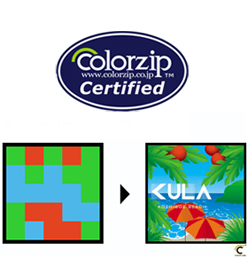
ColorZip Japan now announces [ColorZip Certified Program] to give certificate to our trusted partners and their products. The program is set to find creative design or hardware companies who can cooperate with us to make the ColorCode designs or improve hardware. After thoroughly evaluating creativity, robustness of their product and technology, ColorZip's Partnership is certified and official logo is provided. With the ColorCode, you can appeal your reliability and expand business chances. Image Credit: ColorZip Japan, Inc.

Imagine the possibilities of reaching out to consumers on-the-fly when ColorCodes can be read quickly and easily from a 15 foot distance by mobile phones, Cell PDAs, PCs, and other devices equipped with cameras. Say good-bye to exclusively communicating through one-dimensional print display methodologies.

Excerpts from ColorZip Japan, inc. website -

There's a colorful new world to be explored.

Point your mobile phone at a model in a magazine ad and zip you're visiting her website.

Point your Cell PDA at a music video on TV and zip you've got a sample of the hit single.

Point your cell phone at your favorite team's logo and zip you know the score.
That's the power of ColorZip.

ColorZip works with mobile phones, PC cameras, and other imaging devices that read ColorCodes. Let's say you see a poster for a movie you're interested in. Point your mobile phone at it. The camera in your phone reads a ColorCode printed on the poster. The ColorCode contains information provided by a server. The server then sends data to your phone in the form of content, perhaps a movie trailer. Best of all, it happens instantly, in a zip.


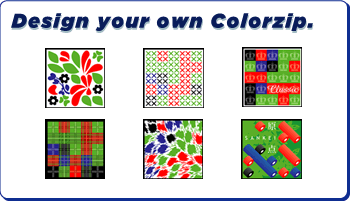
The ColorCode was exhibited at the AUTO-ID EXPO by SATO (printers) held at TOKYO BIG SIGHT. The flower motif ColorCode is for use on flower tags at a florist or nursery. Image Credit: ColorZip Japan, Inc.

Every picture tells a story.

ColorZip also makes watching TV an interactive experience. Suppose you see a product you like on a TV show or commercial. Point your mobile phone at the screen and zip, you can order the product. Perhaps you're watching a TV quiz show. With ColorZip you could play along from home, "answering questions" with your phone and instantly winning prizes.

There are more than 17 billion color patterns available in a 3 mm square code, and in larger codes the possibilities are infinite. Codes can be created in wide variety of shapes, sizes and colors and printed on paper, fabric, glass and other materials. They can appear as corporate and brand logos, designer labels, photos, and virtually anything you can imagine.


It's only a matter of time before the world around you is painted with ColorCodes. Wherever you go, wherever you look -- TV, magazines, store shelves, shopping bags, billboards, web banners, T-shirts and more -- you'll see ColorZip in action.
All you need to do is zip.
Reference Here>>


ColorCodes from Origin through Mobile Site have been designed by the Sankei Co Ltd.'s desingners. The design represents their corporate profile and philosophy. Image(s) Credit: ColorZip Japan, Inc.

Excerpts from Newsweek International via MSNBC early this year-

Using Color Codes To Browse the Web
By Christian Caryl (with B. J. Lee in Seoul) - Newsweek International - Jan. 16, 2006 issue

It's an advertiser's dream. Imagine you're sitting in your favorite cafe when something in the business pages catches your eye. That company you're reading about sounds intriguing. So you take out your mobile phone and focus the camera lens on a small splotch of color embedded in the corner of the article. Suddenly the phone's screen is displaying real-time stock prices and up-to-the-minute company headlines.

It's become a truism that the Internet is transforming the way businesses reach their customers. But among advertisers there's a nagging sense that the online world is still too disconnected from more traditional media, like print. For most users, gaining access to the Internet still means sitting in front of a computer and hammering away at a keyboard - a setup far removed from the experience of reading the morning paper or thumbing through a magazine. Advertisers would instead like to give print readers immediate access to the full range of Web-based information. Colorzip Media, a South Korea-based company, is one of the numerous small firms hoping to bridge this divide.

Colorzip's idea is to build on the pros of bar codes while shedding the cons. The intricate structure of bar codes makes them hard to read; scanners have to be close and precise. And if anything else gets in the way - an ad, for example - the scanner can't cope.


A few years ago Korean computer scientists came up with a new kind of code based on color patterns, which can be easily incorporated into company logos or other graphic designs. Colors are much easier for scanners to read, and they help users home in on the content. Colorzip codes have the added advantage of simplicity.

The design highlights the Skype logo and uses plenty of Skype light blue within the ColorCode. Image Credit: ColorZip Japan, Inc.

Unlike a data-heavy bar code, all a Colorzip code communicates when it's scanned is an index, a pathway to content stored on a server. That links the reading device to the desired content which then pops up on the screen.

Even better, the colors can be read at relatively long distances - say, half a meter away and at poor resolutions. Colorzip codes have already been used on TVs, for example, with viewers voting to express their preferences for the outcome of a show. You focus your phone's camera on a splotch of color in the corner of the screen and press the button; you then find yourself at a Web site.

"We're able to put content onto the code to make it attractive," says Christopher Craney, CEO of Colorzip's Japan subsidiary.
----
But who goes to the trouble of carrying around a scanner? The answer: 60 percent of mobile-phone users in South Korea and Japan. Their phones come with Quick Response readers, based on a code
[a 2D code - QR Code invented by DENSO WAVE CORPORATION] that's somewhere between bar codes and the version proposed by Colorzip. With some software from Colorzip, users can zap everything from specially made Colorzip postage stamps issued by the postal service to T shirts or caps marked with jazzy graphics, and be directed to a Web site.

The technology has a drawback. Because the codes can be photographed or copied, they might be susceptible to hacking.
----
But the color codes may presage a day when the combination of user-friendly codes and the Google-sifted Net universe opens up myriad possibilities.
Read All>>

Check out the most powerful 3D/Auto ID "Cubed" code designed to date>>