Wednesday, January 31, 2007

Behavior-Tuned Intranet Search Engine Delivers Sales

Aggregate Knowledge Logo - Image Credit: Aggregate Knowledge/Krause Taylor Associates

Behavior-Tuned Intranet Search Engine Delivers Sales At Overstock.com

Online retailer Overstock.com, wanting to try a new way of helping customers find products they might be searching for, came to Aggregate Knowledge for some help.

They decided to implement a new software product offered by Aggregate Knowledge known as Discovery Window™, which allowed customers logged on to the Overstock.com network to incorporate the dynamic and intuitive processes built into this new search engine.

What makes the Discovery Window™ unique is that the process seeks to emulate a typical shopper, as if they were walking down an avenue looking into shop windows. Being able to anticipate and program human behavior into a search engine may be a daunting task, but Aggregate Knowledge feels they have hit on something, in that, Overstock.com’s sales were enhanced by over 20% on all products purchased this past holiday season.

Aggregate Knowledge's Discovery for Retail web service drives product discovery and navigation for online retailers for leveraging the collective behavior of customers to anticipate and surface relevant content suggestions. Delivered as a web service, Discovery for Retail helps merchants move beyond keyword search by enabling customers to discover new, relevant items they hadn't yet considered. Discovery for Retail furthers customer relationships by facilitating outbound email communications tailored to users' interests and purchase behavior. Discovery-enabled email campaigns yield significantly greater conversion rates than those without personalized suggestions. Screen Image Credit: Aggregate Knowledge

Said Paul Martino, Aggregate Knowledge's founder and CEO, "Our experience with Overstock and others proves that harnessing the wisdom of crowds delivers breakthroughs in site ease-of-use, customer conversion and shopping cart size."

Excerpts from an announcement released at DEMO 07 Conference in Palm Desert -

New Internet Discovery Service from Aggregate Knowledge Drives Over 20% of Holiday Purchases on Overstock.com
Aggregate Knowledge delivers breakthrough in online sales with new approach to Web search and navigation
Released by Aggregate Knowledge - San Mateo, CA and DEMO '07 - January 30, 2007

Over 20% of all products purchased this holiday season at online retailer Overstock.com were discovered by consumers using the new "discovery window" powered by Aggregate Knowledge. Aggregate Knowledge’s Discovery for Retail™ Web service drives product discovery and navigation for Overstock by leveraging the collective behavior of its customers to anticipate and surface relevant suggestions. The service lets retailers move beyond traditional search, allowing their customers to discover new, relevant items they hadn't yet considered.

"Keyword search is great if you know what you're looking for," said Paul Martino, Aggregate Knowledge's founder and CEO. "But how do you find those things you know are out there when you don't know the two or three magic words to type into Google? Our Discovery Services emulate the way consumers find products they want when they are offline - by observing the behavior of other people.

"For example, you notice a small boutique and something in the window catches your eye, so you enter and purchase it. Or, you notice a waiter delivering a dessert to the next table and think 'I’ll have what she's having.' With the introduction of Discovery for Retail, these serendipitous discoveries can now happen online as well."
Aggregate Knowledge's Discovery Window™ provides Overstock with a 'window' into its 800,000-plus SKU database, delivering customers' suggestions that instantly adapt to their choices. Prior to Aggregate Knowledge, managers relied on various expensive and arcane enterprise software packages.

Aggregate Knowledge's Collective Discovery Network is the industry's first service to bring discovery across multiple online sites. Instead of just showing books related to additional books or news stories related to other news stories, Aggregate Knowledge's Collective Discovery Network surfaces relevant content regardless of type or location. Unlike a traditional ad network that places advertisements in front of customers, the Collective Discovery Network delivers relevant content, products, and services where they will be best received. Screen Image Credit: Aggregate Knowledge
----
"Aggregate Knowledge has exceeded our demanding expectations," said Patrick Byrne, Overstock.com’s CEO. "Our customers love the new choices they are given and we are thrilled with the results - higher sales conversions, larger shopping cart sizes and increased customer engagement and satisfaction."

Aggregate Knowledge achieves a breakthrough in discovery and navigation by observing the anonymous behavior of prior customers to anticipate each new user's intent and to surface relevant options. Since Aggregate Knowledge requires neither personal information nor site registrations, both personal identity and proprietary information remain secure.

According to Byrne, the deployment of Aggregate Knowledge's Discovery Service was quick and painless. "There were skeptics in our organization when Aggregate Knowledge said they could deploy their service in about two weeks," he said. "But they delivered in 16 days, and we started generating additional revenue instantly. We are thrilled with our relationship with Aggregate Knowledge and will be rolling out additional Aggregate Knowledge services throughout the year."

Based on a super computer architecture that can aggregate billions of data points in real time, Aggregate Knowledge's Discovery Services are ideal for retail sites with hundreds of thousands of SKUs. Without Aggregate Knowledge’s technology, shoppers would only be able to find a fraction of the items on a site that might interest them.
Read All>>

Saturday, January 27, 2007

mCode Mobility Symbology Is Making Moves

Examples of Nextcode's mCode when paired up with a corporate "physical world connection" or hyperlink that communicates information directly to one’s cellphone --- "Just Point, Shoot, And Watch" --- Information at one's fingertips. Image Credit: Nextcode/ConnexTo/The Pondering Primate

mCode Mobility Symbology Is Making Moves

Most people are familiar with barcodes; they appear on almost every product we purchase. These barcodes are used to identify the products we purchase so that the pricing and other information (inventory and etc.) is easily retrieved from a computer database. In the case of a barcode, it is a little like a license plate.

But what happens when one wants more than simple identification from a symbology? The symbology has to evolve to meet the application.

When cellphones with cameras were first introduced, most thought ... "How novel, now I don't have to carry two devices in my travels, I have communications and a way to capture my travel experience. How cool, but don't I get better images from a dedicated camera?"

Enter the information age through a better symbology. Enter Nextcode.

This mission statement from the Nextcode website -

Nextcode

Nextcode's mission is to help remove the usability barriers to mobile content, commerce and services. We help eliminate countless keystrokes, bypass cumbersome menus and thus help companies improve their services, better merchandise content, expand offerings and enhance customer satisfaction. By doing so, they increase revenue, build loyalty and create happy customers.

Nextcode Logo - Image Credit: Nextcode Corp

At Nextcode, we see camera phones as just the beginning. In fact, if you look closely, it’s not really a camera inside your handset at all. Rather, it's an image sensor that just happens to have the software to process image data into photos. But the potential for mobile imaging is exponentially greater than taking snapshots. And we provide the enabling technology to help you offer services, provide benefits, open opportunities and make consumers’ mobile experiences easier, richer, and more fun.

Let us help you open up imaging opportunities for your business, because today, in their phones, hundreds of millions of consumers are carrying image sensors everywhere they go. Image sensors, coupled to powerful processors, wirelessly linked to the Internet. Hundreds of millions more are coming soon.

Reference Here>>

Ok! so now one has a code that is more easily read by a cellphone, but what does this mean to me? How am I or my company able to access the power of this new type of communication power?

Create your own physical world connection. Create a hyperlink to a website that is tailored to be seen by a cellphone screen.

Enter ConnexTo, a service of Nextcode.

This from ConnexTo (TM) -

ConnexTo

ConnexTo is a product of Nextcode Corporation, a leader in barcode scanning solutions for camera phones. We help remove usability barriers to mobile content, commerce and services. Our solutions help eliminate countless keystrokes and bypass cumbersome menus help consumers do more with their phones. We also help companies improve their services, better merchandise content, expand offerings and enhance customer satisfaction.

ConnexTo Logo - Image Credit: Nextcode Corp.

ConnexTo uses mCode, a special 2D code format developed specifically for camera phones and mobile applications. mCode is based on patent pending technology based on years of R&D with image sensors, optics, and camera phone applications. It provides breakthroughs in flexibility, data density, aesthetics, and performance. As a result, it is easy to use with standard cell phones. mCode is also designed for the requirements of advertisers, mobile content providers and consumers who want to open up the possibilities of a wide range of capabilities of mobile phones, content and commerce.

Use your camera to take you to websites in a snap. Enter SMS messages without wearing out your fingers. Share detailed contact info with just a click. ConnexTo makes your phone smarter, your life easier and your fingers a lot happier.

Just load application on your phone and you're ready to do a lot more than take pictures. At ConnexTo.com you can create your own codes, share them and then connect with friends, co-workers, content and an entirely new mobile experience.

ConnexTo. It's easy. It's fun. And - best of all - it's FREE.
Reference Here>>

Here are some examples of applications designed to reach out and communicate via Nextcode's mCode and ConnexTo (through a service called WINKsite).

One can even create a link of communication to a human … or government official. Why not, say, President Bush? Image Credit: Nextcode/ConnexTo


Here’s an example of a corporate application that would help a customer get the most out of the product they produce. How to cook a Butterball Turkey at Thanksgiving --- “Just Point, Shoot, And Watch”. Image Credit: Nextcode/ConnexTo/Butterball

Using WINKsite,(http://winksite.com) anyone can set up their own mobile site in minutes that's available worldwide from any web-enabled phone or desktop PC. Each mobile site is outfitted with RSS-friendly features that make it easy to glue together content from blogs and feeds with community features such as chat, forums and polls. Over 10,000 individual publishers and brands have created direct-to-consumer mobile portals and sites. WINKsite - Your Life. Your Friends. Your World. Image Credit: Nextcode/ConnexTo/WINKsite

ht: The Pondering Primate

Thursday, January 25, 2007

RFID And "Speedpassing" Payment Hits The Slopes

Planet Snow Tools comes thru big time, installs over eleven rails and two jumps on Mainline Trail just above Main Lodge. Image Credit: Snö Mountain

RFID And "Speedpassing" Payment Hits The Slopes

Just when you thought "sketching" couldn't get any hotter, along comes a way you can hit the slopes without money or ID to get lost or stolen after pulling off a Stiffy air-Fakie in the half-pipe.

Wrist bands with RFID proximity antennas and memory allow you to be counted as a paid up member for the lifts and while you're at it, a contactless ATM/Credit Card for all of your incidentals.

Skiers at a Pennsylvania ski lodge won’t have to worry about carrying cash when they show up on the slopes. One wrist band will do the trick, providing entry to the ski lift as well as allowing them to make purchases. Image Credit: Precision Dynamics

So, with a wave of the wrist, I'll just pay for the Mountain Dew to go with that cheeseburger ... and while I'm at it, I'll buy those new Oakley, SHAUN WHITE SIGNATURE SERIES A FRAME goggles I've been meaning to get.

This from Contactless News -

Snö Mountain implements Precision Dynamics' RFID wristbands for ski lift passes and cashless purchases
Contactless News - Wednesday, January 24 2007

SAN FERNANDO, CA -- Precision Dynamics Corporation (PDC), a global leader in automatic wristband identification, announces the implementation of its Smart Band RFID Wristband System at the recently renovated Snö Mountain (formerly Montage Mountain) in the Pocono Mountains, Pennsylvania. Snö Mountain, an alpine ski and multi-season recreation center, opened on January 12, 2007.

The RFID wristband system provides added conveniences to guests including automated ski lift tickets and cashless point-of-sale (POS). Purchasing food and beverages at the ski park is a breeze using Smart Band's contactless payment feature. Guests can load money onto their wristband at POS stations using cash, credit or debit cards. Smart Bands work well in any environment -- wet or dry -- making them a great addition to any ski resort.

"Implementing PDC's RFID system will allow us to focus on the customer's overall experience and added convenience, setting Snö Mountain apart from the competition," says Denis Carlson, President of Snö Mountain. "Also, having a cashless payment option will help increase spending at POS locations such as the Snö Grill."


Snö Mountain expects over 175,000 visitors to the ski park this winter season and approximately 500,000 visitors during the summer season at Snö Cove waterpark. The Pocono Mountains are a popular resort and vacation area for residents of Pennsylvania, New York, New Jersey and Maryland. This is PDC's second RFID implementation in this area, with Great Wolf Lodge being the first. For more information on Snö Mountain, visit www.snomtn.com.
Reference Here>>

Monday, January 22, 2007

Mobility Device Gives Palm OS A New, Robust Life

Banner Ad photo from Janam Technologies website. Image Credit: Janam Technologies LLC

Mobility Device Gives Palm OS A New, Robust Life

Last week, on the floor of the National Retail Federation's "Big Show 2007", a company was displaying a new mobility data collection device designed to bring the next version of the Palm OS operating system into the retail marketplace in an upgraded, more robust way.

What makes this noteworthy is that there have been a few changes in the data collection market niche and these changes had put the Palm OS operating system in jeopardy of being orphaned or even left behind. The original company that had developed the Palm Pilot and Palm operating system software was sold to another company in Japan and one of the largest manufacturers of data collectors, Symbol Technologies, did not have its licensing agreement to use the Palm OS software extended or renewed. To complicate matters, Symbol Technologies was also purchased by one of the largest manufacturers of communications equipment and phones in the world, Motorola.

Symbol Technologies was having to walk away from a market that they had established through first placing pedestrian PDA technology in data collection environments, then making the PDA with its Palm OS more robust and capable to handle a greater number of tasks. A massive number of these devices were placed in the field without a plan to continue to improve or integrate technologies as they became available.

A couple of former Symbol employees recognized that this niche, the Palm OS PDA-based data collector niche, might end up on the side of the road with a bunch of satisfied customers not having a place to go to find a current "next version". Enter Janam Technologies LLC - a new start-up company that announces "Migration is now as easy as it was meant to be".

Close-up of XP30 Series QVGA Color screen. Image Credit: Janam Technologies LLC

Excerpts from a news item found at PDAsNEWS -

Janam Technologies and PalmSource Announce Five-Year Agreement
By Dimitris S. - Published on 11/9/2006

Janam Technologies LLC, a provider of rugged mobile computers that scan barcodes, and ACCESS Systems Americas, Inc., a member of the ACCESS CO., LTD., group of companies, today announced a licensing agreement that enables Janam to develop and sell application-specific mobile computers based on the latest version of ACCESS' Palm OS Garnet until 2011. In addition, Janam today announced its rugged, barcode-scanning, PDA-format mobile computers that will offer all the winning features of Palm OS Garnet, while still supporting barcode-scanning applications written for earlier versions of Palm OS. More than 40 million Palm Powered mobile phones, handhelds, and other mobile devices have been sold worldwide. With over 29,000 Palm OS application software titles available today, the Palm OS platform offers one of the largest third-party software catalogs to enable users to customize their Palm Powered smart mobile devices to fit particular needs.


"This is a story of investment protection," said Harry B. Lerner, Co-CEO of Janam. "Value-added resellers and their customers who have invested millions of dollars over the last 10 years in barcode-scanning applications for the durable Palm OS platform will now have cutting-edge hardware to which they can migrate their existing applications effortlessly, while adding newer functionality that further extends their solutions."
----
Janam’s XP Series rugged mobile computers combine the benefits of the Palm OS® Garnet™, including long battery life, a simple development environment and overall system stability, with the advanced technical features found in typical industrial mobile computers that run on alternative operating systems, in a much smaller and lighter package - all for up to half the list price.

XP20 Series features a Monotone screen, 266MHz CPU, PDA and Numeric keyboards, Batch or WLAN, 1D symbology scanner only. Image Credit: Janam Technologies LLC

The XP20 Series features a custom, "bright white", 160 x 160, monochrome display that was developed to provide continuity with today’s Palm OS® industrial mobile computers.


XP30 Series features a QVGA Color screen, 266MHz CPU, PDA and Numeric keyboards, Batch or WLAN, choice of 1D scanner or 2D imager scanner. Image Credit: Janam Technologies LLC

The XP30 Series adds a color, quarter-VGA display and Bluetooth as standard.

Hand Held Products' tiny 5000 series image engine is a revolutionary combination of a digital camera, illumination optics, and aiming optics. Devices powered by Adaptus Imaging allow you to capture signatures, take photos, read virtually all bar codes - even damaged codes - and so much more. Best of all, it allows you to tackle emerging applications with confidence - protecting your investment well into the future. Image Credit: Hand Held Products

All XP Series products offer a 2D barcode scanning option [not supported by distributor documentation - All XP20 Series products are offered with 1D scanner only / All XP30 Series products are offered with a choice of 1D or 2D scan engines], meet IP54 sealing requirements, withstand drops to concrete from 4'/1.2m and weigh less than 10 ounces. The XP Series will be the world's first, rugged, mobile computer that combines Palm OS Garnet (version 5.4), numeric keypad option, user-accessible memory, NAND flash memory backup, USB connectivity, double capacity battery option and, in WLAN versions, WiFi Protected Access (WPA) wireless security.

With easy management of accessories in mind, Janam will also offer a single-slot charging/synching cradle, four-slot charging/synching cradle, USB synching/charging cable and attachable magnetic stripe reader (MSR) that works with all XP Series mobile computers.

Read All>>

Also, these excerpts and reflections from VARBusiness -

Symbol Bids Adieu To Palm, Start-up Seeks To Fill Void
By Shelley Solheim, VARBusiness - From the November 27, 2006 VARBusiness

Partners who have tested out the new devices say they think the products will fill a market need.

"The Palm OS base is shrinking, but there definitely remains strong demand from customers who need an aggressive barcode scanner with a simple application at a low price point -- something that Palm OS excels at," says Brad Horn, Portable Technology Solutions, a provider of mobile barcode enabled data collection solutions. "These customers cannot afford and do not need the higher end features bundled in with the Windows Mobile and CE.Net Terminals. The Janam terminal is a great fit for these price sensitive customers."

"There is still a Palm market out there. We found some customers were pretty upset with the end-of-life with Symbol's program," says Tom Moxley, president of Next Level Solutions, in Scottsdale, Ariz. "This will give the Palm user a good window to convert so he can do it on his timetable not with his back to the wall."

There is another small provider of rugged Palm-based devices based out of New Zealand, called Aceeca, although its devices are based on an older version of the Palm OS.

Read All>>

At the time of this post, the first production units are expected to ship out in the first half of Q1. List pricing of the XP Series devices is expected to range from $995.00 to $1,545.00 depending on how the XP Series device is configured.

The renewed focus, improvements, and upgrades of this OS developmental effort may translate into greater functionality of the PALM OS in general.

Sunday, January 14, 2007

Auto ID meets TIME Magazine’s Person Of The Year!

Time Magazine cover of December 25, 2006. Cover reads - "Yes you. You control the information age. Welcome to your world." Image Credit: Time Inc.

Auto ID meets TIME Magazine's Person Of The Year!

You.

As the Time Magazine cover says, "Yes You! ... but at ShopperTrak, it is not what you think.

When someone thinks of triggers for Auto ID and tracking, one instantly thinks of barcodes, or RFID tags, or even biometrics like fingerprints. At ShopperTrak, its you … your body moving through time and space in an "X", "Y" field.

At NRF's Big Show (this week in New York at the Jacob Javitz Center) ShopperTrak is a featured technology in the NRF X07 Ultimate Pop-Up Boutique located in Booth 2555. What this technology does with two tiny CCD cameras mounted at about ceiling height is unobtrusive and invalueable.

The most accurate and most popular customer traffic counter in the industry, ShopperTrak's Orbit utilizes an on-board video sensor with high speed processing components to unobtrusively track customers' movements. Image Credit: ecj

American Eagle Outfitters, Payless Shoes, and Chicago's O'Hare airport, have found that the ability to track a person's (body) movement through a space and the information that comes from analyzing these movements, returns great dividends to their business effort.

Excerpts from ShopperTrak –

SHOPPERTRAK NAMED EXCLUSIVE TRAFFIC COUNTING TECHNOLOGY PROVIDER FOR NATIONAL RETAIL FEDERATION'S X07 STORE OF THE FUTURE
Retail Intelligence Leader to Provide Real-Time Pedestrian Foot Traffic Count During State-of-the-Art Exhibit at NRF's 96th Annual Convention, January 14-17, in NYC
By ShopperTrack - January 8, 2007 - Chicago

ShopperTrak RCT, the world's leading provider of retail traffic intelligence solutions and services, will be the exclusive provider of traffic intelligence for the National Retail Federation's (NRF) X07 "Store of the Future" exhibit during the group's 96th Annual "Big Show," January 14-17, at New York's Jacob K. Javits Convention Center.

NRF's X07 is a state-of-the-art pop-up boutique that will feature the most innovative technologies and futuristic design elements aimed at captivating the ever elusive young adult shopper, as well as interactive kiosks and displays throughout the 11,000-square-foot exhibit. Featuring multiple vendors, X07 will resemble a miniature version of a future store - highlighting the newest technologies such as cell phone interaction, colorful and dynamic light displays, floating sound and theatre systems, digital wireless floor video displays, and RFID payment and self-checkout kiosks.

ShopperTrak (Booth #2405), will employ its Orbit retail intelligence system, which utilizes an on-board video sensor and multiple high-speed microprocessors to unobtrusively measure foot traffic, to track attendees entering and exiting the innovatively designed X07 exhibit . With the Orbit sensor positioned at the exhibit's entrance point, ShopperTrak will stream traffic data to a video display allowing show attendees and exhibitors alike to view the X07 traffic count in real time. Additionally, NRF will have the ability to effectively track head count throughout the lifespan of X07, allowing the organization to identify the most heavily-trafficked time spans throughout the two-day exhibit.

In a retail environment, ShopperTrak's Orbit technology provides the precise data needed to make key business decisions, telling managers how many shoppers enter the store, as well as allowing them to calculate their conversion rate, or how many of those shoppers are converted to sales. ShopperTrak's web-based Retail Traffic Analyzer seamlessly integrates extensive data from the Orbit sensor and delivers a series of user-friendly analysis tools, dashboards and reports to help store managers see their periods of peak traffic, or Power Hours™, and be able to plan for appropriate staffing to optimize conversions.

"As anticipated, the 2006 holiday season was very solid for retailers, with the bulk of this year's strength coming from Black Friday and both the Friday and Saturday before Christmas," noted Bill Martin, co-founder of ShopperTrak - pictured here in front of the display of the ShopperTrak read-out panels in the NRF X07 Ultimate Pop-Up Boutique. Image Credit: ecj

"ShopperTrak's participation in the most innovative exhibit of the industry's premier event is a great compliment to our position as a leader in retail intelligence and traffic-counting solutions," said Bill Martin, co-founder of ShopperTrak. "The opportunity to present real-time traffic data for the X07 exhibit, will allow show attendees to experience a concept that has become a mainstay in retail environments throughout the country."
Reference Here>>

Thursday, January 11, 2007

QR Based PM Code - The Best 3D Symbology Ever, Really!

Normal PM Code with data memory capability uses 8-24 colors. Memory ranges from about 0.6MB~1.8MB (4,083,264 figures). Image Credit: C.I.A.

QR Based PM Code - The Best 3D Symbology Ever, Really!

And it is a 5th Generation Media symbology known as the PM Code. With this printed symbology one can use a simple cellphone with a camera and unleash incredible variants of communication ranging from simple data, to sound, to video … all at the snap of a camera button on the phone.

In the worlds of automatic identification and information technology, the question of what is the best machine-readable information-packed symbology ever has been answered ... Again!

Why?

Well, until someone comes up with a device readable code that can hold about 1.236 GB of information (2,854,408,421,376 figures) - Deliver as much information from a printed media symbology (code) to have a phone with the corresponding decode program and a camera play a low-resolution video with sound for approximately 20 seconds, or have the phone reach out automatically to entertainer, advertiser, and manufacturer websites to retrieve additional database stored information via Internet Protocol … then one can dispute this claim!!!

IP (Internet Protocol) based PM Code uses 256 colors. Memory ranges to about 1,236GB (2,854,408,421,376 figures). Image Credit: C.I.A.

The best symbology ever?

The best symbology ever may well be the PM Code (PM = Paper Memory), developed by a relatively new Japanese start-up company known as Content Idea of Asia Co., Ltd. (C.I.A.), The algorithm basis comes from the DENSO Wave - developed QR Code – originally intended for use in tracking and aiding the complex task of automobile parts manufacturing and sourcing throughout the automobile assembly process.
CL Code with data memory capability. Memory ranges from about 72KB (170,136 figures). Image Credit: C.I.A.

C.I.A. also has developed a “sister” code known as the CL Code (CL = Clear Code) which describes the effect of being able to add a code that does not need to be dark contrast against a light background to be decoded. This allows the information reference code to be laid on top of media in a transparent, layered look - in order to not take away from the printed media onto which it is applied.

Simple CL Code application in tomato photo. Image Credit: C.I.A.

The advantages of using the CL Code is that the customer’s viewing of marketing designs and images will not be hampered due to the application of an identifying Physical World Hyperlink or Physical World Identifier/Connection for the customer to use when getting additional information. One technique suggests that the CL Code may be printed in a band of matching product colored ink on the bottle. The information would not be able to be decoded until the contents of the bottle have been consumed or poured out … thus leaving the CL Code in a readable format.


Content Idea of Asia Co., Ltd. Explains the concept this way. Both the CL Code and its more robust “sister” PM Code are examples of 5th Generation Media.

What does this "5th Generation Media mean? Well,

1st Generation Media refers to paper media such as magazines, newspapers, and other printed media stratum.

2nd Generation Media refers to audio radio communication.

3rd Generation Media refers to television, video, and film media communications.

4th Generation Media refers to Information Technologies (IT) found in the digital world of computers and cellular telephones.

So now we come full circle and fuse the previous forms of communication together.

5th Generation Media allows the fusion of all forms of media to interact and cooperate, in order to take the advantage of each form to deliver a more effective level of communication through the application of this unique database found in a 3D (three-dimensional) color QR based code. A simple cellphone with a camera can unleash incredible variants of communication ranging from simple data, to sound, to video - YES VIDEO! … all at the snap of a camera button on the phone.

No IP address – just the PM Code and the “old media” adverts come to life! Applications include listening to portions of songs, videos, short how-to-use vignettes, security for access control, save, re-write, and store data media on flat format paper (instead of CD’s, DVD’s, or HD discs), and well, the sky is the limit.

Hey, how’s this - you are a curator of a museum and you would like the patrons to enjoy the exhibit a little more deeply with sound descriptions of what they are seeing. Place PM Codes next to each display and voila, the patron can hear all they wanted to know about the painting and the painter - complete with a video snippet on the painter’s technique. All of this interactive information without involving the audio/visual department and/or the equipment investment.

Next up?

The addition of smell - Okay, so this may be a little overboard ... but you get the idea!


HT: Content Idea of ASIA co., Ltd.

Sunday, January 07, 2007

Software Company Captures Mobility Decode Patent

Microsoft's Don Dodge, Director of Business Development for Microsoft's Emerging Business Team Picks Scanbuy As A Company To Watch In 2007 (December 20, 2006). Image Credit: Scanbuy, Inc.

On January 2, 2007, the United Stated Patent Office issued a patent to Scanbuy, Inc. (New York, NY) for a "System and method for decoding and analyzing barcodes using a mobile device".

The method will be known commercially as "ScanZoom" software and will enable a user of a cellphone with a camera to achieve a connection to objects and their corresponding websites and/or database information contained within the symbology that is scanned. This ability to connect to objects through digital information and electronic devices is becoming known as "physical world connection" and the symbol or rfid trigger the electronic device decodes or gets information from - a "physical world hyperlink" or PWH.

Soon all objects will have a PWH so that one will be able to connect and know the information about any object anywhere.

Patent #7,156,311 was issued to Scanbuy, a company Microsoft identifies a primary physical world connection player, with the following information found at the United States Patent and Trademark Office website.

Excerpts from United States Patent and Trademark Office -

Abstract

The present invention discloses a system and method for decoding barcodes using mobile device. Generally, the barcode image is acquired via a digital camera attached to the mobile device. After the barcode image has been acquired, software located on the mobile device enhances the barcode image and subsequently decodes the barcode information. The barcode information is then transmitted to a server via a wireless network. The server processes the barcode information and transmits media content related to the barcode back to the mobile device.


SUMMARY OF THE INVENTION

The present invention provides a software application and system (hereinafter referred to as "ScanZoom") designed to successfully process and decode barcodes acquired via digital imaging techniques. ScanZoom software empowers a user to use a cell-phone or PDA equipped with a digital camera as a scanner of barcodes (one-dimensional and two-dimensional) or any other similar machine-readable code. It seamlessly integrates the barcode scanning technology with the digital camera (built-in or attached) of the cell phones/PDAs/Pocket PCs.

To utilize the ScanZoom software, a user downloads the ScanZoom onto his/her cell phone or PDA through wireless access protocol ("WAP"), infrared, or Bluetooth.RTM. connectivity. However, any protocol which allows a user to download a program to a mobile device may be utilized to download ScanZoom. Once the user has downloaded ScanZoom, the user launches the application. This causes ScanZoom to properly initialize the digital camera coupled to the mobile device to accept input. It starts the digital camera by calling its Application identification.

The user then takes a picture of the barcode using the digital camera. As soon as the barcode is captured, the ScanZoom software decodes the barcode utilizing a decoding engine integral to the ScanZoom software. Alternatively, the Scanzoom software may send the image of the barcode to a central server for decoding by sending a multimedia message service ("MMS") message to the server containing the barcode image.

If ScanZoom sends a MMS message to the server, it launches the MMS Application Id, composes the appropriate message on the fly, and then sends the message to the SMS/MMS server. On the server side, a global system for mobile communications ("GSM") modem connected to the server has the appropriate security identity module ("SIM") card and takes the services from any mobile service provider. The server fetches the MMS message from the GSM modem queue and performs appropriate action depending upon the message. The server can then send back a simple SMS message or can send back a multimedia message service ("MMS") message which can launch a WAP browser on the mobile device and direct it to the appropriate website, or send back information to the user through any other existing wireless protocol.

The location of the decoding depends entirely upon the processing capabilities of the mobile device utilized. For example, if the ScanZoom software is operating on a mobile device with lower system capabilities, such as a first generation camera phone, the mobile device will automatically send the digital image of the barcode to a server for decoding.

The barcode decoding engine continuously runs in a loop until it's able to decode the image taken by the digital camera into a barcode. If the barcode cannot be properly resolved, the user is prompted to take another picture of the desired barcode.

Additionally, the barcode decoding may also be performed in real time. The ScanZoom software accomplishes this by constantly capturing and processing the image of the barcode until it is correctly decoded. This eliminates the extra step of the user having to press a button to capture an image of the barcode.

After the barcode has been correctly resolved either by the mobile device or the server, the mobile device displays the appropriate media content to the user. The media content displayed to the user depends entirely on the barcode scanned. For example, if a user scans a barcode on a compact disc, the ScanZoom application may launch a WAP browser and direct the user to a site which allows the user to purchase the compact disc electronically. As another example, if a user scans a barcode located on a food item, the server may return a SMS message to the mobile device indicating the nutritional contents of the scanned item.

Current Product Description: SCANBUY Media allows content providers and advertisers to streamline the access to mobile content by assigning to a dedicated two-dimensional (2D) barcode one or several WAP destinations. Image Credit: Scanbuy, Inc.

Therefore, it is an object of the present invention to provide a software application and system capable of accurately and reliably decoding barcodes and other machine-readable codes acquired via a digital camera connected to a mobile device.

Another object of the present invention is to provide a software application and system which allows for the decoding of barcodes in a wide range of conditions.

An additional object of the present invention is to provide a software application and system for decoding barcodes which is quick and responsive.

Yet another object of the present invention is to provide a software application and system for decoding barcodes which is robust under adverse lighting, imaging, and focusing conditions.

Still another object of the present invention is to provide a software application and system for decoding multiple barcode formats.

Another object of the present invention is to provide a software application and system which does not adversely affect device performance, usability, or form factor.

Furthermore, an object of the present invention is to provide a software application and system for decoding barcodes which does not significantly impact device power consumption nor degrade general camera performance.

It is another object of the present invention to provide a barcode decoding system which requires minimal or no changes to the manufacturing process of the mobile devices.

An additional object of the present invention is to provide a barcode decoding system having a low incremental cost per device.

Another object of the present invention is to provide a highly reliable barcode decoding system requiring minimal user support.

These and other objects of the present will be made clearer with reference to the following detailed description and accompanying drawings.

Reference Here>>

Current Product Description: With SCANBUY Shopper, we now give consumers the power to become educated. Our ultimate mobile software allows them to compare retail prices with online prices right from their cell phone, and be sure they walk away with the best deal, wherever they are. Image Credit: Scanbuy, Inc.

As for Scanbuy, the company's mission statement states the following -

MISSION STATEMENT

SCANBUY enables camera phones to capture and immediately decode printed or electronically displayed barcodes. One scan to stream music, watch trailers, download ringtones, access information, and shop with your cell phone.

SCANBUY solutions are designed for handset manufacturers, wireless carriers, content providers and retailers.

SCANBUY integrates its products with an array of business platforms and provides SDK to be utilized with other proprietary solutions.

Reference Here>>

ht: The Pondering Primate

Tuesday, January 02, 2007

Popular Science Magazine's "Best Of What's New"


Memory Spot - HP Unveils Revolutionary Wireless Chip That Links the Digital and Physical Worlds; Grain-Sized Chip Could Be Attached to Almost Any Object, Making Information More Ubiquitous. Image Credit: HP via The Pondering Primate

Popular Science Magazine's "Best Of What's New" 2006:

Originally introduced in a press release on July 17, 2006, this experimental chip, developed by the "Memory Spot" research team at HP Labs, is a memory device based on CMOS (a widely used, low-power integrated circuit design) and about the size of a grain of rice or smaller (2 mm to 4 mm square), with a built-in antenna.

The Memory Spot chips could be embedded in a sheet of paper or stuck to any surface, and could eventually be available in a booklet as self-adhesive dots (easy and productive).

The applications for a small RFID tag such as this are many and with no equal in terms of its combination of size, memory capacity and data access speed. The tiny chip could be stuck on or embedded in almost any object and make available information and content now found mostly on electronic devices ... or even the Internet.

This from Hewlett-Packard -

Memory Spot chip wins Popular Science award

December 2006 -- Memory Spot, a wireless data chip that could help bridge the physical and digital worlds, received a 2006 "Best Of What's New" award in general innovation from Popular Science Magazine.

Developed in HP Labs Bristol, U.K., the chip provides high storage capacity and bandwidth comparable to standard RFID tags. The tiny chip can be stuck on or embedded in almost any object and make available information and content now found mostly on electronic devices or the Internet.

Potential applications include storing medical records on a hospital patient's wristband; providing audio-visual supplements to postcards and photos; helping fight counterfeiting in the pharmaceutical industry; adding security to identity cards and passports; and supplying additional information for printed documents. The chip is not yet available for commercial use.

" 'Best of What's New' is the ultimate Popular Science accolade, representing a year's worth of work evaluating thousands of products," says Mark Jannot, the magazine's editor. "These awards honor innovations that not only influence the way we live today, but that change the way we think about the future."

The 12-inch tall, hexagonal crystal trophy will be displayed in the main lobby of HP Labs Palo Alto, HP Labs headquarters, through the end of the year. At that time, it will go permanently to HP Labs Bristol.

Reference Here>>

Components of a "Memory Spot" CMOS chip - This is not just a robust, wrapped antennae with some memory as is the case with a standard RFID Tag. Image Credit: HP via The Future Of Things website

Additional information from a Hewlett-Packard press release -

Memory Spot chips have numerous possible consumer and business-based applications. Some examples are:

** Medical records: Embed a Memory Spot chip into a hospital patient's wrist band and full medical and drug records can be kept securely available.

** Audio photo: Attach a chip to the prints of photographs and add music, commentary or ambient sound to enhance the enjoyment of viewing photos.

** Digital postcards: Send a traditional holiday postcard to family and friends with a chip containing digital pictures of a vacation, plus sounds and even video clips.

** Document notes: A Memory Spot chip attached to a paper document can include a history of all the corrections and additions made to the text, as well as voice notes and graphical images.

** Perfect photocopies: A Memory Spot chip attached to a cover sheet eliminates the need to copy the original document. Just read the perfect digital version into the photocopier and the result will be sharp output every time, no matter how many copies are needed, and avoiding any possibility of the originals jamming in the feeder.

** Security passes: Add a chip to an identity card or security pass for the best of both worlds - a handy card with secure, relevant digital information included.

** Anti-counterfeit tags: Counterfeit drugs are a significant problem globally. Memory Spot chips can contain secure information about the manufacture and quality of pharmaceuticals. When added to a drug container, this can prove their authenticity. A similar process could be used to verify high-value engineering and aviation components.

Read All>>

This technology may find itself involved in privacy controversies ... giving a new meaning to the Lionel Richie song titled "Stuck On You"!


Additional Photos Link>>

Saturday, December 23, 2006

Biggest Readable AutoID Code ... Ever!

A QR Code printed 36 feet by 36 feet on a banner and hung on the side of a building in Hiroshima, Japan. Image Credit: PlusD Mobil/IT Media, Inc.

Biggest Readable AutoID Code ... Ever!

A new first, and it comes back to the strength and dynamics of the best Auto ID Code created. The Quick Response Code (QR Code) that was first developed by DENSO Wave (a Toyota company) is finding its way around the applications world in many and unique open and closed source application environments.

In this case, this application and display (pictured above) may go down as the World's Largest readable automatic identification symbology EVER ... that is if the Guiness Book of World Records agrees.

This QR Code was created and displayed on the side of a new apartment building in Hiroshima, Japan. Since most of the camera mobile phones in Japan take clear pictures, users can just snap the QR code and read the content with their cellphone.

The information contained in the cameraphone readable display has the URL of the website for the apartment along with other information such as a map and directions to this location.

Directly translated form Japanese to English at Plus D Mobil -

Plus D Mobil/IT Media, Inc.

Recognition of the QR cord/code corresponds at many of camera equipped carrying, the object just is photographed has URL to ahead the notification sight and the feature which can verify various character string informations with carrying. The thought of utilizing also the expedient which can acquire information easily with impact and carrying of the super enormous QR cord/code the leaflet and the television and the newspaper etc in addition to the announcement expedient which has done from the past, liking to do notiifying widely.

As for size of announcement curtain 15.3 (height) ×14.58 (width) as for meter and size of QR cord/code 10.97 (height) ×10.97 (width) meter. The same company makes “size the greatest in the world as the QR cord/code which can be grasped,” is the register application to the Guinness book that it did.

Installation features of enormous QR cord/code

Installation features: The hiroshima city Aki Ku Yanotou 1 Chome wall surface of "[hurorensu] Yanotou gland arc first mansion" and "[hurorensu] Yanotou gland arc second mansion"

Installation period: [hurorensu] Yanotou gland arc first mansion: 2006 December ~2007 year

February schedule: [hurorensu] Yanotou gland arc second mansion septentrional wall surface: 2007 March ~2007 year

May schedule: Information of offer Apartment feature, campaign contents, model room MAP other things
Reference Here>>

Friday, December 22, 2006

Broadly Used Consumer Technologies Driving IT?

"Stuff" from another world - Image Credit: The Economist

Broadly Used Consumer Technologies Driving IT?

"Off the shelf/over the portal" applications made easy ... too easy.

A contributor to SlashDot - fiannaFailMan writes to point out The Economist's reporting on the way consumer-driven software products are increasingly making their presence felt in the corporate world. Some CIOs are embracing the influx while others continue to resist it.

Excerpts from an article in The Economist -

Work-life balance
From The Economist print edition - Dec 19th 2006 SAN FRANCISCO

IN OCTOBER, shortly after taking over as head of information technology (IT) at Arizona State University, Adrian Sannier gave the nod to his contact at Google, the internet giant known for its search engine, and with one flick of the proverbial switch 65,000 students had new e-mail accounts. Unlike the university's old system, which stores e-mails on its own server computers, the new accounts reside on Gmail, Google's free web-based service. Mr Sannier is not forcing anybody to change but has found that the students, many of whom were already using Gmail for their private e-mail, have been voluntarily migrating to the new service at a rate of 300 an hour. Crucially, they can take their "asu.edu" e-mail addresses with them.
----
For Mr Sannier, however, a bigger reason than money for switching from traditional software to web-based alternatives has to do with the pace and trajectory of technological change. Using the new Google service, for instance, students can share calendars, which they could not easily do before. Soon Google will integrate its online word processor and spreadsheet software into the service, so that students and teachers can share coursework. Eventually, Google may add blogs and wikis - it has bought firms with these technologies. Mr Sannier says it is "absolutely inconceivable" that he and his staff could roll out improvements at this speed in the traditional way - by buying software and installing it on the university's own computers.

In the past, innovation was driven by the military or corporate markets. But now the consumer market, with its vast economies of scale and appetite for novelty, leads the way. Compared with the staid corporate-software industry, using these services is like "receiving technology from an advanced civilisation", says Mr Sannier. He is now looking at other consumer technologies for ideas. He is already using Apple's iTunes, a popular online-music service, to store the university's podcasts.

Mr Sannier is ahead of his time because most IT bosses, especially at large organizations, tend to be skeptical of consumer technologies and often ban them outright. Employees, in return, tend to ignore their IT departments. Many young people, for instance, use services such as Skype to send instant messages or make free calls while in the office. FaceTime, a Californian firm that specialises in making such consumer applications safe for companies, found in a recent survey that more than half of employees in their 20s and 30s admitted to installing such software over the objections of IT staff.

Executive toys
Consumer technologies such as IM usually make employees more productive, says Kailash Ambwani, FaceTime's boss, so IT bosses should concentrate not on stopping them but on making them secure. In the case of IM and some kinds of file-sharing, the risks are that viruses or spyware could come into the corporate network from the outside, or that employees could ship vital information outward.

With Google Apps for Your Domain and other software services that are accessed through a web browser, the security issues are more subtle. Since the software and the data reside on the service provider's machines, the danger is of losing control of sensitive data, which is now in somebody else's hands. Most IT bosses find this scary. Not so Mr Sannier. He remembers a picture that Google showed him of one of its data centres burning to the ground; it looked awful. The point, however, was that no users of Google services anywhere even noticed, because Google's systems are built to be so robust that even the loss of an entire data centre does not compromise anybody's data.
----
This trend could cause problems for traditional software firms such as Microsoft, Oracle and SAP. Already, start-ups such as Salesforce.com and NetSuite provide "software as a service", supplying sales-force automation, accounting, payroll and other features via the web. (Marc Benioff, the founder of Salesforce.com, had the idea for his firm while browsing on Amazon's online store one day. Why, he wondered, could business software not be delivered the same way?) Other firms, including Google, provide web-based e-mail, word processing, spreadsheets and databases.

Big companies will probably keep "mission critical" systems in-house. But as everything else migrates to web-based services, software will increasingly resemble the web technologies of the consumer market, says Mr Benioff. Those enterprise firms, such as his own, that follow the lead of consumer-oriented websites will do well in this environment, he argues.

Security concerns, Mr Benioff implies with a wink, are red herrings thrown by ageing IT bosses trying to justify their salaries.
Read All>>

This comment found in reaction to the Slashdot posting -

I can see many companies might have issues with the security of their documents or data being held by 3rd party companies but once that hurdle has been jumped it seems to me to make sense so long as you (the company) can still have the same control you would were you hosting the service yourself.

Really, this is just outsourcing particular aspects of your business to specialists which is something a lot of companies now have a lot of experience in.

For example, the company I'm currently working for - develop software for their own warehouses and distribution network because the success of this directly affects their ability to compete in the market - but they also have a team of people managing their mail servers and providing support for office applications which they could certainly benefit in not doing themselves provided the alternative was cheaper and as effective.

Wednesday, December 20, 2006

Mickey D's Inventive Use Of 2D QR Codes

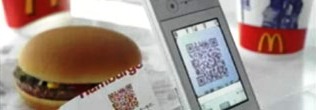
Image taken from video showing cellphone datacapture from a hamburger wrapper. Image Credit: McDonald's CM

At Symblogogy, we have explored the use of symbologies and cellphone camera technology working together in harmony.

Here is a unique consumer information application which is simple to implement and an effective way to meet a customer's need for information.

McDonald's CM


A customer with a cellphone, programmed to read QR Codes, simply points the camera to the QR Code printed on the wrapper and - Voila! - nutrition information at one's fingertips - quick, simple, and easy ... providing that the catsup (or cheese) isn't smeared on over 30% of the code ... otherwise, the QR Code will reconstruct and it's good to go.

Friday, December 15, 2006

Sick RFID tags - A Real Threat To Systems

When an unsuspecting reader scans an infected tag, there is a danger of the tag exploiting vulnerability in the middleware to cause unwanted actions to occur, which may include infecting the database. This is a photo of the world's first RFID tag identified with a virus. Image Credit: Department of Computer Science, Vrije Universiteit Amsterdam

"Sick" RFID tags - A Real Threat To Systems

Many who work with RFID systems falsely believe that the only threat of virus infection to the computer's programs is through the standard entry points (new program downloads and transference, emails, hackers, and etc.).

A new entry point has been found and at this point, there are no ironclad defenses to this simple act of just "scanning a tag".

Excerpts from the Department of Computer Science, Vrije Universiteit Amsterdam -

RFID Viruses and Worms
By Melanie R. Rieback, Patrick N. D. Simpson, Bruno Crispo, Andrew S. Tanenbaum - Department of Computer Science, Vrije Universiteit Amsterdam

Unfortunately, businesses and governments are not the only ones interested in RFID. Civil liberties groups, hackers and criminals are also keenly interested in this new development, albeit for very different reasons. Civil liberties groups are concerned about RFID technology being used to invade people's privacy; RFID tags enable unethical individuals to snoop on people and surreptitiously collect data on them without their approval or even knowledge. For example, RFID-enabled public transit tickets could allow public transit managers to compile a dossier listing all of a person's travels in the past year -- information which may be of interest to the police, divorce lawyers, and others.

However, privacy is not the focus of this website and will not be discussed further below. On the other hand, we are intensely concerned about privacy in an RFID-enabled world and have built an entire sister website about a device we have constructed, called the RFID Guardian, which could potentially help people protect their privacy from RFID snooping in the future. Those interested in RFID and privacy might want to check it out at www.rfidguardian.org. The website even includes a video of the prototype RFID Guardian in action.

A completely different category of threats arises when hackers or criminals cause valid RFID tags to behave in unexpected (and generally malicious) ways. Typically, computer-bound or mobile RFID readers query RFID tags for their unique identifier or on-tag data, which often serves as a database key or launches some real-world activity. For example, when an RFID reader at a supermarket checkout counter reads the tag on a product, the software driving it could add the item scanned to the list of the customer's purchases, tallying up the total after all products have been scanned.

Here is where the trouble comes in. Up until now, everyone working on RFID technology has tacitly assumed that the mere act of scanning an RFID tag cannot modify back-end software, and certainly not in a malicious way. Unfortunately, they are wrong. In our research, we have discovered that if certain vulnerabilities exist in the RFID software, an RFID tag can be (intentionally) infected with a virus and this virus can infect the backend database used by the RFID software. From there it can be easily spread to other RFID tags. No one thought this possible until now.
----
While we have some hesitation in giving the "bad guys" precise information on how to infect RFID tags, it has been our experience that when talking to people in charge of RFID systems, they often dismiss security concerns as academic, unrealistic, and unworthy of spending any money on countering, as these threats are merely "theoretical." By making code for RFID "malware" publicly available, we hope to convince them that the problem is serious and had better be dealt with, and fast. It is a lot better to lock the barn door while the prize race horse is still inside than to deal with the consequences of not doing so afterwards.

Real-World Scenarios

To make clear what kinds of problems might arise from RFID hacking by amateurs or criminals, let us consider three possible and all-too-realistic scenarios.

I.) A prankster goes to a supermarket that scans the purchases in its customers' shopping carts using the RFID chips affixed to the products instead of their bar codes. Many supermarkets have plans in this direction because RFID scans are faster (and in some cases can be done by the customers, eliminating the expense of having cashiers). The prankster selects, scans, and pays for a nice jar of chunk-style peanut butter that has an RFID tag attached to it. Upon getting it home, he removes or destroys the RFID tag. Then he takes a blank RFID tag he has purchased and writes a exploit on it using his home computer and commercially available equipment for writing RFID tags. He then attaches the infected tag to the jar of peanut butter, brings it back to the supermarket, heads directly for the checkout counter, and pays for it again. Unfortunately, this time when the jar is scanned, the virus on its tag infects the supermarket's product database, potentially wreaking all kinds of havoc such as changing prices.

II.) Emboldened by his success at the supermarket, the prankster decides to unwittingly enlist his cat in the fun. The cat has a subdermal pet ID tag, which the attacker rewrites with a virus using commercially available equipment. He then goes to a veterinarian (or the ASPCA), claims it is stray cat and asks for a cat scan. Bingo! The database is infected. Since the vet (or ASPCA) uses this database when creating tags for newly-tagged animals, these new tags can also be infected. When they are later scanned for whatever reason, that database is infected, and so on. Unlike a biological virus, which jumps from animal to animal, an RFID virus spread this way jumps from animal to database to animal. The same transmission mechanism that applies to pets also applies to RFID-tagged livestock.

III.) Now we get to the scary part. Some airports are planning to expedite baggage handling by attaching RFID-augmented labels to the suitcases as they are checked in. This makes the labels easier to read at greater distances than the current bar-coded baggage labels. Now consider a malicious traveler who attaches a tiny RFID tag, pre-initialized with a virus, to a random person's suitcase before he checks it in. When the baggage-handling system's RFID reader scans the suitcase at a Y-junction in the conveyor-belt system to determine where to route it, the tag responds with the RFID virus, which could infect the airport's baggage database. Then, all RFID tags produced as new passengers check in later in the day may also be infected. If any of these infected bags transit a hub, they will be rescanned there, thus infecting a different airport. Within a day, hundreds of airport databases all over the world could be infected. Merely infecting other tags is the most benign case. An RFID virus could also carry a payload that did other damage to the database, for example, helping drug smugglers or terrorists hide their baggage from airline and government officials, or intentionally sending baggage destined for Alaska to Argentina to create chaos (e.g., as revenge for a recently fired airline employee).

Some companies with a vested interest in RFID technology have said their software can withstand attacks such as the ones we have proposed. We hope that is the case. These claims would be much more believable, however, if the companies made their software available to universities and other neutral parties for exhaustive testing, along with a large reward (say, $100,000) for the first person to construct a virus that successfully infects it. If no one is able to infect the software after, say 6 months, the claim that the software cannot be infected is a great deal stronger than merely stating it without proof. The nice part of this for the company is that if the software is bulletproof, it costs the company nothing.

Reference Here>>

STOP sneezy, drippy, virus laden tags now!

Suggested research links (the links give more technical detail about possible attacks and how to prevent them) - best viewed in order of listing:

RFID Middleware

Classes of RFID Malware

The Architecture of RFID Systems

Vulnerabilities that Can Be Exploited

How to Write an RFID Virus

How to Write an RFID Worm

How to Defend against RFID Malware

Monday, December 04, 2006

"Touchscreen" ANYTHING

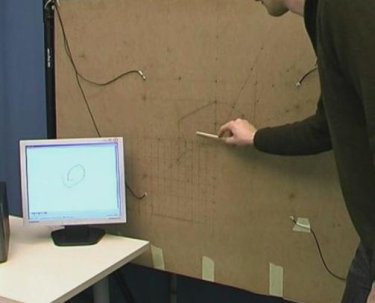
Two or more sensors are attached around the edges of the surface. These pinpoint the position of a finger, or another touching object, by tracking minute vibrations. This allows them to create a virtual touchpad, or keyboard, on any table or wall. The system, called Tai-Chi (Tangible Acoustic Interfaces for Computer-Human Interaction), was developed by researchers from Switzerland, Italy, Germany, France and the UK. "We have made a system that can give any object, even a 3D one, a sense of touch," says Ming Yang, an engineer at Cardiff University, UK, who is coordinating the project. Image From Video - Image Credit: Ming Yang/Tai-Chi Project

"Touchscreen" ANYTHING

Really ... and you don't even need a screen.

"Touchscreen" a plywood board, a plate of glass, a school chalkboard, a field of grass, an icerink, a kitchen sink, a block of wood, and an automobile hood.

Now any surface can be a computer interface surface with the software and microphone sensors used in a system called Tai-Chi which translates to Tangible Acoustic Interfaces for Computer-Human Interaction (demonstration video link below).

So feel free to "touchscreen" for the good ... your whole neighborhood!

This from New Scientist -

Acoustic sensors make surfaces interactive [plus video links]
By Tom Simonite - NewScientist.com news service - 14:22 28 November 2006

A series of acoustic sensors that turn any surface into a touch-sensitive computer interface have been developed by European researchers.

Two or more sensors are attached around the edges of the surface. These pinpoint the position of a finger, or another touching object, by tracking minute vibrations. This allows them to create a virtual touchpad, or keyboard, on any table or wall.

The system, called Tai-Chi (Tangible Acoustic Interfaces for Computer-Human Interaction), was developed by researchers from Switzerland, Italy, Germany, France and the UK. "We have made a system that can give any object, even a 3D one, a sense of touch," says Ming Yang, an engineer at Cardiff University, UK, who is coordinating the project.

A video produced by the researcher shows four sensors attached to a flat, vertical surface, being used to trace a researcher's finger (4.6MB, wmv format). Another video shows a simple interactive instrument developed using the system. The sensors were also used to create an interactive globe that accesses geographical information on a computer screen when the user touches different regions.

'Sonar' tracking

"One advantage of the system is that for little cost you can have a much larger touch-sensitive area," says Yang. "The whole surface of your desk could become your keyboard and mouse-pad."

Tai-Chi uses tiny piezoelectric sensors to sense surface vibrations. The sensors are connected to a desktop computer loaded with software developed by the team and the system can track up to two objects at once, in one of two ways.

One method involves measuring differences in the amount of time vibrations take to arrive at two or three different sensors – a similar approach to sonar. Using this method any surface can be made touch sensitive simply by attaching the sensors.

The other method requires just one sensor and can actually be more accurate – to within just a few millimetres. But this method requires the calibration of the system beforehand, so that it recognises the vibrations caused by contact at different points on the surface. It then uses a database of vibration "fingerprints" to identify the point of contact.

Hygiene

Workplaces in which hygiene is critical, such as hospitals, could particularly benefit from Tai-Chi, says Wang. "Keyboards are very difficult to keep clean and can harbour infection," he explains. "We could have a keyboard drawn onto the desks that would work perfectly and could be disinfected much more easily."

William Harwin, a haptic interfaces researcher at Reading University, UK, thinks Tai-Chi has promise. "It is a very clever idea," he told New Scientist. "The technology is a neat and relatively simple solution to making ordinary objects touch sensitive."

But Harwin adds that users might not find it easy to switch from a normal keyboard to simply tapping on their desk. "People expect a degree of feedback from pushing buttons and switches," Harwin explains. "It is important in giving people a sense of quality."
Reference Here>>

Monday, November 27, 2006

Christmas Shopping Gives Us A Window On The Future

Ralph Lauren's Chicago flagship has a new high-tech function that gives new meaning to "window-shopping." Image Credit: BusinessWeek/images 06/11/1123_xmas

Christmas Shopping Gives Us A Window On The Future

This Christmas, the shopping experience has taken to the streets!

In an innovative and technologically inventive move, Ralph Lauren, Chicago, decided to do more than just decorate its flagship store window for Christmas, it decided to turn the window display into a combination website and Point-Of-Sale checkout station for the self-service minded consumer who happened to be out-on-the-town ... "Window Shopping".

Excerpts from BusinessWeek -

Shopping in a Window Wonderland
Big stores in cities such as Chicago have always hosted fab holiday windows. Now those displays are high-tech, high-end - and crucial to sales
By Reena Jana - BusinessWeek, Innovation - November 23, 2006

Holiday shoppers strolling down Chicago's stylish Michigan Avenue are accustomed to the extravagant window displays beckoning consumers to buy pricey gifts. But this year, the street's Ralph Lauren (RL) store is introducing an unusual alternative, one that gives new meaning to the phrase "window shopping."

On Nov. 20, Ralph Lauren installed a 67-in. touch-screen display that allows passersby to purchase any item from the company's RLX line of high-performance ski-wear - 24 hours a day. They can then retrieve available items from inside the store, or have the clothes shipped from a central warehouse - no long check-out lines necessary.

"Our goal was to do what we thought was the most exciting holiday window we could create," says David Lauren, senior vice-president of advertising, marketing, and communications at Polo Ralph Lauren (and the founder's son). The tech-savvy strategy is designed to appeal to sophisticated early adopters.
----
"We also saw the interactive window as a way to reinterpret the Ralph Lauren brand," ... one that is often associated with traditional, preppy clothing ... "in a very modern way," Lauren says. The touch-screen window also displays informational videos on ski conditions in the jet-set destination of Aspen, and ski tips from experts.
----
A prototype of the Polo Ralph Lauren window debuted in New York, at the Polo Ralph Lauren store at 888 Madison Avenue, during the U.S. Open Tennis Championship in August. Often, crowds lined up around the block to get a glimpse of the window or to purchase clothes using it.

Although Lauren won't divulge the cost of the windows, he jokes that it is about the price of buying an ad in two issues of a weekly print magazine, which is roughly estimated in the $140,000 range. Such a relatively modest sum could fuel a full three months of eye-catching brand promotion vs. two weeks of magazine ads. The Chicago window is scheduled to remain through February 19.
----
The interactive window was inspired by Steven Spielberg's Minority Report, in which Tom Cruise manipulates a giant, vaporous computer screen with his hands like an orchestral conductor. Lauren called Spielberg directly to see if the technology was possible. When he learned that the display was just a digital special effect, he began developing a system internally.

After the prototype debuted in New York in August, Lauren received a phone call from Spielberg. "He called us to find out how it worked," Lauren says of the window. While he can't describe the full technical details, he says the screen's futuristic effects are achieved via rear-projection of images. The touch-sensitive window is enabled by a transparent foil embedded with electrodes.

And it's not only the luxury stores experimenting with new, spectacular ways of drawing in buyers. Macy's Herald Square department store in New York, for example, is featuring interactive window displays for the first time. The concept suggests a children's version of the Ralph Lauren touch-screen windows. Passersby touch pads shaped like red stars (the Macy's logo) to set animatronic figures in motion.

At a time when the National Retail Federation is predicting that total holiday spending will increase 5% in 2006 to $457.4 billion, retailers understand there are potentially more dollars to be made than in previous years. For luxury emporiums and mid-range stores alike, developing a stronger brand identity via show-stopping window displays - or, in the case of Ralph Lauren, interactive sales windows - appears essential to a merry holiday selling season.

Read All>>