Showing posts with label QR Code. Show all posts

Tuesday, January 29, 2013

Umbrella Public Relations Stunt Achieves World Record Claim

Umbrella display: Located within the volcanic region of exotic Hainan Island, Mission Hills Resort Hainan marks a magnificent addition to Hainan's tropical island paradise. Boasting an exceptional variety of world-class lifestyle, recreation and wellness facilities, the Resort is poised to be one of China's most sought-after leisure destinations. Caption and Image Credit: Mission Hills Resort Hainan

Umbrella Public Relations Stunt Achieves World Record Claim

Yesterday, at what has been billed as the world’s largest golf facility, Mission Hills Shenzhen, China, people holding umbrellas on the fairway of a picturesque golf link, claimed a world record by creating a “human” displayed QR Code.

Close-up detail. Image Credit: Mission Hills Resort Hainan

The QR Code was formed by nearly 2,000 staff carrying umbrellas and an aerial photograph was taken from a height of 270 feet so that the code could be used in Press Releases.

The purpose of this PR effort is designed to promote sustainable eco-tourism ... and in celebration of Mission Hills' 20th anniversary, the Group is giving away twenty 3 day / 2 night Romantic Premier Spa Suite Getaway packages at Mission Hills Haikou Resort on the tropical island of Hainan.

When users scan the QR Code, they will be directed to a campaign website to answer three simple questions related to sustainable eco-tourism. Those who complete the questions with the correct answers will be entered into the draw for a chance to win one of the Mission Hills Micro Holiday packages valued at US$2,600.
(ht: PR Newswire)

Say Hi to the world, 1,369 people love Taiwan, the arrangement of the world's largest human OR Code, hands in the air to empty footage Say Hi to let the world see Taiwan, to show the enthusiasm of the people of Taiwan. Caption and Image Credit: Wen Shiren Cultural Foundation and the Taiwan Foundation (taiwansayhi.com)


QR display detail - Wen i Taiwan ‧ wonderful movie tidbits Say Hi to the world activities Video posted January 16, 2013. Image Credit: Wen Shiren Cultural Foundation and the Taiwan Foundation (taiwansayhi.com)

This is not the first time people holding umbrellas stand in a predetermined pattern in order to form a QR Code upon which folks with camera/QR enabled smart phones could scan the code created and be directed to a website to qualify or buy something of value or interest. At the beginning of December last year, 1369 people raised black, white and blue umbrellas to form a QR Code directing people to a website that promotes Taiwan culture and tourism - http://www.taiwansayhi.com.
(ht: 2d)

... Symblogogy


** Article first published as Umbrella Public Relations Stunt Achieves World Record Claim on Technorati **

Saturday, February 25, 2012

The Automating QR (Quick Response) Code, Smart Phones, And You


Loyal customers, who are less likely to shop online, can be enticed by QR codes to come into the store after they have scanned a code and experienced rich videos, images, or in-store contests. Recently luxury retailer Ralph Lauren matched up with Red Fish Media to design a custom QR code placed in windows at various Ralph Lauren locations. Once scanned, the customer was enticed to enter the store for a chance to win tickets to the 2012 men’s US Open finals and a $3,000 Ralph Lauren wardrobe. Image Credit: Ralph Lauren

The Automating QR (Quick Response) Code, Smart Phones, And You

A cellphone with a camera isn’t a communications device with a way to capture pictures and share them with friends … rather, it’s a web enabled handheld data scanner with a display which automates the way to reach out, get information, be involved socially, and get things done.

In order to have one's phone behave more like a tool than a personalized toy, all one has to do is download a simple program into the cellphone and presto – the camera takes a picture (scans) of a symbol printed on a billboard, flyer, magazine, or TV/Computer display screen then decodes it and has the phone access a “(dot) mobi” webpage on the internet through a series of pre-scripted commands. Quick, Simple, and Easy.

Image Credit: Ralph Lauren

So why hasn’t this form of consumer automation taken off in the larger way it has in Japan and other countries? Hard to say, but get ready because the symbology revolution will be vying for your attention at a cellphone, real estate operation, bus stop, television screen, website, or specialty retail store around the corner from where you live, right now ... it's that weird square with squares in it.

There may be many codes (symbologies) offered by program automation developers, each with their own strengths and benefits, however, if your phone has limited memory space in which to store the software necessary to decode the symbology, then the one code program the cellphone should contain is the QR Code … the best code ever.

Image Credit: Ralph Lauren

This excerpted and edited from Multichannel Merchant Magazine -

R U Ready 4 QR Codes?
By Tim Parry, Multichannel Merchant

CONSIDERING MOBILE MARKETING? Then you should probably start thinking about quick response (QR) codes. These two-dimensional barcodes can provide a vital link between print or broadcast media and mobile commerce.
----
WHAT ARE THEY? QR codes store information — namely mobile Website URLs — that can be read by devices with cameras, like cell phones. A user with a Web-enabled camera phone equipped with the QR reader software can scan the image of the QR code; decoding software reads the information and prompts the phone's browser to go to a programmed URL.

WHAT'S THE BENEFIT TO YOU? Let's say you have a QR code printed on an advertisement or catalog. A customer could scan it with his cell phone to be directed to your mobile site — and hopefully start buying immediately.

IS ANYBODY USING THEM? Upscale apparel brand Ralph Lauren, for instance, burst onto the mobile commerce scene in August using the technology. The merchant put QR codes on print advertisements, store windows and mailers so that with one wave of a Web-enabled camera phone — with QR reader software — the user is whisked away to a landing page at m.ralphlauren.com.

The mobile site was initially launched back in 2008 with a showcase of its limited edition U.S. Open Collection and other Ralph Lauren classics such as polo shirts, oxfords and chinos. Mobile users could also check out a Ralph Lauren style guide, watch tennis videos, and read articles about the U.S. Open in real time.

“We see mobile as a key channel for marketing, advertising and commerce for all of our brands and retail concepts,” says Miki Berardelli, Ralph Lauren's vice president, global customer strategy and retail marketing. “QR codes are part of the strategy and they serve as a conduit, providing an easy way for people to access the mobile Web.”

Users can download the QR reader application for free from Ralph Lauren; the technology is also available from numerous other sources online.

David Harper, founder/CEO of Website development firm Engagelogic and mobile content management and social networking software company Winksite, hopes the Ralph Lauren launch will encourage others to incorporate QR codes in their mobile commerce campaigns. But the early adaptors like Ralph Lauren may need to do more to educate people about the technology.
----
Why aren't more using QR codes? Creating a basic QR code is easy enough: Multichannel Merchant generated the code that appears on this issue's cover in a matter on minutes on Winksite.com. (Test it with your cell phone camera.)

Dave Sikora, CEO of m-commerce provider Digby, blames a lack of consumer awareness of the technology, and the inability of phones to accurately read the codes.
----
But Harper contends that adding a QR code reader application to a phone is no harder than downloading software to your personal computer. You can do a search for “QR code reader” on your mobile browser and find a site you want to download it from. Once installed, the reader application will show up in the applications folder, and its icon will appear on the screen.

And the QR reader does not have to point perfectly perpendicular for the QR code to be correctly translated by the mobile device, he adds. Even a wave over the code can bring the user to the correct mobile site.
----
Big in Japan

QR codes can be seen everywhere in Japan — no surprise, since Japanese firm Denso-Wave created the technology in 1994. Cell phone users in Japan can click a QR code printed on a poster at a movie theater and view its trailer.

It helps that QR code readers come as a standard feature on many smart cell phones.
----
“When a customer scans the barcode with their phone, it launches a mobile-ready product detail and ordering page,” says Nina Matthews, marketing coordinator for CBC America. “This enables the customer to grab the page for follow-up while on the go or for sharing with others.”
----
Once consumers embrace the technology, Harper envisions some merchants using QR codes on the covers of their catalogs. Eventually, they may generate individual codes to be used for each product offering.

Technology notwithstanding, Digby's Sikora wonders how some merchants would handle the creative elements of incorporating a QR code into their print advertising and catalogs.
[Reference Here]

Image Credit: Ralph Lauren

FAQ's from Ralph Lauren -

Frequently Asked Questions (very basic)

What is a mobile site?
A mobile site is simply a normal web site formatted to fit your mobile phone or device.

Is it necessary to download anything to shop the mobile site?
No. Just enter m.RalphLauren.com into your mobile phone browser and voila...

Can any phone access the mobile site?
Any phone equipped with a web browser can access m.RalphLauren.com.

Will it cost me on my phone bill to use the mobile site?
This service is free from Ralph Lauren but charges from your carrier may apply. Be sure and double-check your plan.

Is it secure to shop from my phone?
Yes. Shopping via mobile device is just as safe as shopping from your home computer.
----
What is a QR code?
These are two-dimensional bar codes—just like you’d find at the grocery store—that direct you to a specific website when you scan them with your cell phone.

[Reference Here]


** Article first published as The Automating QR (Quick Response) Code, Smart Phones, And You at Technorati **

Monday, October 13, 2008

The QR (Quick Response) Code And You

Image Credit: Ralph Lauren

The QR (Quick Response) Code And You

A cellphone with a camera isn’t a communications device with a way to capture pictures and share them with friends… rather, it’s a web enabled handheld with a display and a scanner which automates the way to reach out, get information and get things done.

In order to have one's phone behave more like a tool than a personalized toy, all one has to do is download a simple program into the cellphone and presto – the camera takes a picture (scans) of a symbol printed on a billboard, flyer, magazine, or display screen then decodes it and has the phone access a “(dot) mobi” webpage on the internet through a series of pre-scripted commands. Quick, Simple, and Easy.

Image Credit: Ralph Lauren

So why hasn’t this form of consumer automation been adopted right here in North America (after all, in large consumer societies found in Europe and Japan, this kind of symbology enabled automation has been used and perfected for years. Fact is, this is why a camera was added to the cellphone in the first place.)? Hard to say, but get ready because the symbology revolution will be vying for your attention at a cellphone or specialty retail store around the corner from where you live, soon.

There will be many codes (symbologies) offered, each with their own strengths and benefits, however, if your phone has limited memory space in which to store the software necessary to decode the symbology, then the one code program the cellphone should contain is the one to decode the QR Code … the best code ever.

Image Credit: Ralph Lauren

This excerpted and edited from Multichannel Merchant Magazine -

R U Ready 4 QR Codes?
By Tim Parry, Multichannel Merchant - Oct 1, 2008 12:00 PM

CONSIDERING MOBILE MARKETING? Then you should probably start thinking about quick response (QR) codes. These two-dimensional barcodes can provide a vital link between print media and mobile commerce.
----
WHAT ARE THEY? QR codes store information — namely mobile Website URLs — that can be read by devices with cameras, like cell phones. A user with a Web-enabled camera phone equipped with the QR reader software can scan the image of the QR code; decoding software reads the information and prompts the phone's browser to go to a programmed URL.

WHAT'S THE BENEFIT TO YOU? Let's say you have a QR code printed on an advertisement or catalog. A customer could scan it with his cell phone to be directed to your mobile site — and hopefully start buying immediately.

IS ANYBODY USING THEM? Upscale apparel brand Ralph Lauren, for instance, burst onto the mobile commerce scene in August using the technology. The merchant put QR codes on print advertisements, store windows and mailers so that with one wave of a Web-enabled camera phone — with QR reader software — the user is whisked away to a landing page at m.ralphlauren.com.

The mobile site initially launched with a showcase of its limited edition 2008 U.S. Open Collection and other Ralph Lauren classics such as polo shirts, oxfords and chinos. Mobile users could also check out a Ralph Lauren style guide, watch tennis videos, and read articles about the U.S. Open.

“We see mobile as a key channel for marketing, advertising and commerce for all of our brands and retail concepts,” says Miki Berardelli, Ralph Lauren's vice president, global customer strategy and retail marketing. “QR codes are part of the strategy and they serve as a conduit, providing an easy way for people to access the mobile Web.”

Users can download the QR reader application for free from Ralph Lauren; the technology is also available from numerous other sources online.

David Harper, founder/CEO of Website development firm Engagelogic and mobile content management and social networking software company Winksite, hopes the Ralph Lauren launch will encourage others to incorporate QR codes in their mobile commerce campaigns. But the early adaptors like Ralph Lauren may need to do more to educate people about the technology.
----
Why aren't more using QR codes? Creating a basic QR code is easy enough: Multichannel Merchant generated the code that appears on this issue's cover in a matter on minutes on Winksite.com. (Test it with your cell phone camera.)

Dave Sikora, CEO of m-commerce provider Digby, blames a lack of consumer awareness of the technology, and the inability of phones to accurately read the codes.
----
But Harper contends that adding a QR code reader application to a phone is no harder than downloading software to your personal computer. You can do a search for “QR code reader” on your mobile browser and find a site you want to download it from. Once installed, the reader application will show up in the applications folder, and its icon will appear on the screen.

And the QR reader does not have to point perfectly perpendicular for the QR code to be correctly translated by the mobile device, he adds. Even a wave over the code can bring the user to the correct mobile site.
----
Big in Japan

QR codes can be seen everywhere in Japan — no surprise, since Japanese firm Denso-Wave created the technology in 1994. Cell phone users in Japan can click a QR code printed on a poster at a movie theater and view its trailer.

It helps that QR code readers come as a standard feature on cell phones in Japan and Australia. And Harper says they're starting to become standard in certain parts of China, such as Beijing. (The software remains open-source in the U.S., though Nokia did add it to its N95 model.)
----
“When a customer scans the barcode with their phone, it launches a mobile-ready product detail and ordering page,” says Nina Matthews, marketing coordinator for CBC America. “This enables the customer to grab the page for follow-up while on the go or for sharing with others.”
----
Once consumers embrace the technology, Harper envisions some merchants using QR codes on the covers of their catalogs. Eventually, they may generate individual codes to be used for each product offering.

Technology notwithstanding, Digby's Sikora wonders how some merchants would handle the creative elements of incorporating a QR code into their print advertising and catalogs.
Reference Here>>

Image Credit: Ralph Lauren

FAQ's from Ralph Lauren -

Frequently Asked Questions
What is a mobile site?
A mobile site is simply a normal web site formatted to fit your mobile phone or device.

Is it necessary to download anything to shop the mobile site?
No. Just enter m.RalphLauren.com into your mobile phone browser and voila...

Can any phone access the mobile site?
Any phone equipped with a web browser can access m.RalphLauren.com.

Will it cost me on my phone bill to use the mobile site?
This service is free from Ralph Lauren but charges from your carrier may apply. Be sure and double-check your plan.

Is it secure to shop from my phone?
Yes. Shopping via mobile device is just as safe as shopping from your home computer.

What can I buy through m.RalphLauren.com?
Right now, you can purchase anything from our US Open collections and our RL Classics shop as well as our iconic Ricky Bag. In the coming months, more and more products will be available and eventually you will be able to shop a range of Ralph Lauren products from anywhere you take your mobile phone.

What is a QR code?
These are two-dimensional bar codes—just like you’d find at the grocery store—that direct you to a specific website when you scan them with your cell phone. Learn more about QR, how to get it, and what type of device you need to operate it HERE.

Reference Here>>

Friday, September 28, 2007

The Image Of A Mobile (phone) World

Japanese commuters while away the journey by watching TV on their mobiles. Image Credit: David Sacks/Getty

The Image Of A Mobile (phone) World

Portable programmable electronic communication devices, which received their birth forty years ago with the release of the T58 & T59 by Texas Instruments, have come a long way and there is no better place in the world than Japan to judge and assess how far.

The key to this evolution comes down to having the handheld cellphone be an on-the-fly, symbology decoding, self-programming computer. A cellphone with a good processor, a camera, a printed symbology (ie. slang: barcode) and a strong infrastructure can deliver more interaction and information than a WiFi internet connection HotSpot on many applications.

The most amazing application that can be delivered through these means is that a person with a properly programmed cellphone can scan a “3D Barcode” (a colorized QR Code) and the phone decodes the image taken with the camera and delivers to the cellphone screen 20 seconds of video communication to the user. That’s right! … 20 seconds of the latest DVD release from “The Bourne Ultimatum” that might help one to decide to buy this DVD gift for Christmas – for example.

PM Code - Colorized QR Code that can deliver a 20 second video to the users phone screen without the need to be hooked-up to a WiFi HotSpot or incur cellphone call minutes. Image Credit: Content Idea of Asia (CIA)

Furthermore, the cellphone user did not have to use the cellphone radio towers or a WiFi Hotspot to have the handheld perform this amazing feat. The 20 seconds of video came directly from the “Barcode” that the user’s phone took a picture of … and decoded to display.

More mobility application news happening in Japan from The Guardian Unlimited -

Why mobile Japan leads the world
A combination of an urban lifestyle and infrastructure advantages mean that the fixed internet is being left behind by the mobile

Michael Fitzpatrick - The Guardian - Thursday, September 27, 2007

Yasuko San is aiming her mobile at a small, square tattoo on paper, clicking a little and peering happily at the result. Her prize? The latest novel written for the mobile, entitled "Teddy". Such serialised novels for mobiles are just the latest phone application that has caught the Japanese imagination, but - apart from neighbouring South Korea - few others.

Those printed square icons, however, made their debut in the UK earlier this month (to promote the DVD of the film 28 Weeks Later). Known as QR (quick read) codes, they have aided Japan's mobile revolution by making it easy to access a web page via mobile. Users can be directed to sites by snapping the codes printed in magazines, posters and even on biscuits.

PM Code Image as captured via the cellphone camera. Image Credit: Content Idea of Asia (CIA)

Mobile subscribers

Their British outing is a full four years behind Japan's adoption. In fact, we lag Japan in nearly every aspect of mobile use - except possibly in annoying other commuters on trains.

Lost in Japan? Let your mobile's GPS guide you. Bored? Download the latest manga comic or an e-book to read on the train, or go shopping and pay by swishing your mobile in front of the till, because the phone is also an electronic wallet.

You can also collect e-coupons, pay bills, play Final Fantasy, update your blog and pay and check into hotels wirelessly. Soon the airport check-in will be history in Japan, too, as the e-ticket in your phone becomes your boarding pass.

Nearly all are services based on the success of the mobile web in Japan, where in a nation of 127 million the number of mobile internet subscribers recently passed 100 million. Not for nothing are the Japanese now known as the Thumb Tribe - a tribe who, for the most part, prefer their mobile to the fixed internet.

Apart from the killer application - email - 80% say they use other functions too. Downloading music is popular (80% have tried it), as is TV for mobile - half of its subscribers use it regularly. Three quarters of users say they enjoy online clothes shopping with their mobile at least once a month. What they are less keen on is video calling: in Japan, as in the UK, 90% say "no thanks, never". And as for using the mobile as a modem - to link to the internet - that's very expensive in Japan.

It is no wonder those touting m-commerce as the next big web thing tell us Japan is the future blueprint. "Japan is the world's high-tech testbed for a wide range of consumer electronic devices and systems - many of which never see the light of day in overseas markets," says Daniel Scuka, keitai guru and consultant for publishers Wireless Watch Japan. "So keeping up with developments here is vital to knowing what's going to hit Europe and the US 24 months in the future; doubly so with respect to mobile and wireless."

By offering the Japanese a multiplicity of services - and, very importantly, some very cool handsets to use them on - the operators have created what every western mobile service provider is dreaming of: a mobile lifestyle culture that keeps millions reaching for the mobile rather than the fixed internet. But it does have its disadvantages.

Most us would feel miffed if we lost or damaged our mobiles. The Japanese would be paralysed without theirs: nearly half of Japanese confess to being obsessed with their mobile phones.

But why is such technology such a hit in Japan and not in other mobile-savvy nations such as Finland? According to the man who kickstarted the trend - the father of i-mode, NTT DoCoMo's Takeshi Natsuno - it is because of the Japanese genius for designing new technologies that can be adopted by anyone, especially techno-phobes. It's not about "bandwidth, nor standards, nor unique Japanese culture", he says. It is about "fun and convenience".
----
Demanding consumers

The Japanese are blessed with some of the best-looking technology in the world. It has to be intuitive, simple and high-quality, not because the Japanese are so tech-savvy, but because they are the most demanding consumers in the world.

According to Scuka, more than 100 new phones hit the Japanese market last year as manufacturers tried out new ideas on the public. Some cultural factors, as with any other country, do play a part in Japan's willingness to take up some technologies such as TV on the mobile.

As in Europe, this was at first a washout, but as watching TV in public becomes more socially acceptable in Japan, the number of subscribers is rising. Au, the second largest mobile network in Japan, recently signed up its five millionth subscriber to the service.
----
It is this urban lifestyle where convenience is the key which has necessitated the rise of the all-in-one mobile plus those very funky handsets. By comparison Apple's iPhone is a mere 2.5G plaything. In Japan, which is already into 3G and heading towards 4G, they make mobiles look good and work hard.
Reference Here>>

Tuesday, April 03, 2007

Symbology Development Growth Gets MSM Attention

The pattern on a building in Tokyo is filled with information that can be read by a properly programmed cellphone with a camera. The technology can also be used for many other things, like buying airline tickets. Image Credit: Ko Sasaki for The New York Times

Symbology Development Growth Gets MSM Attention

Yes, that’s right, the Main Stream Media (MSM) here in North America is finally taking notice that cellphones and symbologies make good bedfellows (New York Times – “New Bar Codes Can Talk With Your Cellphone” – April,1 2007).

Ok, so they think, improperly so, that all symbologies are “Bar Codes” but the concept is clear – camera enabled cellphones are NOT phones with cameras … they are imagers with a way to link oneself with information either in the phone itself with decoding software, or to the internet via an automated software hyperlink function.

Again, all of this functionality is available now and has been a staple in the cellphone users world in Japan, Korea, The Philippines, and in many places throughout Europe.

As with anything else, the question comes down “monetization” … in other words, how do businesses make money through this proposition while giving the consumer what it wants?

Also, there are many types of symbologies, each designed to achieve a desired effect for the user of the program that is tied to the symbology that the phone is scanning.

Excerpts from The New York Times -

New Bar Codes Can Talk With Your Cellphone
By LOUISE STORY - The New York Times - Published: April 1, 2007

It sounds like something straight out of a futuristic film:
House hunters, driving past a for-sale sign, stop and point their cellphone at the sign. With a click, their cellphone screen displays the asking price, the number of bedrooms and baths and lots of other details about the house.

Media experts say that cellphones, the Swiss Army knives of technology, are quickly heading in this direction. New technology, already in use in parts of Asia but still in development in the United States, allows the phones to connect everyday objects with the Internet.

In their new incarnation, cellphones become a sort of digital remote control, as one
CBS executive put it. With a wave, the phone can read encoded information on everyday objects and translate that into videos, pictures or text files on its screen.

“The cellphone is the natural tool to combine the physical world with the digital world,” that executive, Cyriac Roeding, the head of mobile-phone applications for CBS, said the other day.

In Japan,
McDonald’s customers can already point their cellphones at the wrapping on their hamburgers and get nutrition information on their screens. Users there can also point their phones at magazine ads to receive insurance quotes, and board airplanes using their phones rather than paper tickets. And film promoters can send their movie trailers from billboards.

Advertisers say they are interested in offering similar capabilities in the United States, but cellphones in the States do not come with the necessary software. For now, consumers have to download the technology themselves.
----
“Everything in the physical world has information related to it somewhere electronically, including yourself and the desk you’re sitting in,” said Chas Fritz, chief executive of NeoMedia Technologies, a company developing these cellphone capacities.

The most promising way to link cellphones with physical objects is a new generation of bar codes: square-shaped mosaics of black and white boxes that can hold much more information than traditional bar codes. The cameras on cellphones scan the codes, and then the codes are translated into videos, music or text on the phone screens.
----
In Japan, the codes did not become mainstream until the largest cellphone companies started loading the code readers on all new phones a few years ago. Now, millions of people have the capability built into their phones, and businesses, in turn, are using them all over — on billboards, street signs, published materials and even food packaging.
----
“There are three things you tend to carry — your keys, your wallet and your phone,” said Rishad Tobaccowala, chief executive of Denuo, a unit of the Publicis Groupe that focuses on emerging and future technologies. “I can see something in advertising in one place, scan it with my phone and recall it later when I am shopping. Or, imagine, I can buy it using my phone.”

About a third of the 84 million households with cellphones in the United States have phones that have cameras on them, according to Forrester Research, and that number is expected to grow as consumers replace their phones. But few people with those phones have downloaded the software to read the codes.

In Japan, some highway billboards have codes large enough for passing motorists to read them with their phones. Hospitals put them on prescriptions, allowing pharmacies to instantly scan the medical information rather than read it. Supermarkets stick them on meat and egg packaging to give expiration dates and even the names of the farmers who produced them.

One of the most popular uses in Japan has been paperless airline tickets. About 10 percent of the people who take domestic flights of All Nippon Airways now use the codes on their cellphones instead of printed tickets.
----
The new technology would allow phones to read the codes from computer screens, too.

Commuters rushing out the door could scan Web sites on their computer screens with their phones to take the content with them. MySpace users could put a code on their personal pages, so that their friends can quickly transfer the profiles to their phones.
----
In the Philippines, the Daily Philippines newspaper has run ads with the codes. In Britain, News Group Newspapers, the division of the News Corporation that includes newspapers like The Sun, is testing the codes along with some of its sports articles. Readers can scan the code in the newspaper and then see videos relating to the article. Similarly, Economie Matin, a magazine in France, is testing the codes.

In the United States last fall, the Canadian alternative rock band Barenaked Ladies placed the codes on concert posters. The publisher Prentice Hall is including the codes in a new marketing textbook for undergraduates so that they can get updates on case studies using the codes.

Executives at Verizon, AT&T and Sprint declined to say whether they were in discussions with the companies that make the code reading technology. Bar code companies said the carriers stood to benefit from the codes because they might encourage consumers to add Internet service plans to their accounts and spend more time on their phones.

The wireless companies have other options to help cellphones interact with the physical world.

They could, for instance, adopt image recognition software, which would allow phones to recognize anything — a Coca-Cola can, for example — and deliver related messages. Or, text messaging, currently the most common way that advertisers interact with consumers on their phones, has many advertiser applications.

Advertisers have also experimented with Bluetooth wireless devices and radio frequency identification to beam messages from billboards to consumers’ cellphones, but those technologies are more expensive than the codes.

Even if the wireless companies adopt the bar codes, they will have several formats to choose from. The most widely used ones have names like Semacode, QR Code and Qode.

Getting consumers to use new technologies like these codes takes a lot of marketing by the carriers, said David Oberholzer, associate director of content programming at Verizon Wireless. He said Verizon is just starting to profit from the work it did to create interest in text messaging.

“The consumer needs a reason to do it,” said Jim Levinger, chief executive of Nextcode, a bar code company. “They don’t just wake up and say, ‘Hey, let’s go scan some bar codes.’ ”
Read All>>

Here is a short comparison graphic. The graphic is by no means complete with all of the symbology application developments that have been underway for use in the PWC/PWH marketplace. The graphic shows what the Main Stream Media missed in the telling of their "discovery".

Comparison Graphic: Highlights some of the major symbologies (as the MSM says - "bar codes") and their comparative strength for use as camera phone implementers. Image Credit: Symblogogy (based upon estimates of statistical information)


For those who have the interest and the time, one can perform a demonstration of this "Code Connection" on their own cellphones. Just follow the Demo Link at the NYTCODE (subscription may be required)!

Friday, March 02, 2007

Sex And The Web 2.0 - Or, When Denim Meets QR Code

French model wearing the first web-enabled, cellphone-interactive upscale casualware denim (jeans). Image Credit: Denim Code Press Release

Sex And The Web 2.0 - Or, When Denim Meets QR Code

Never has a symbology or denim jeans material ever looked so good.

This type of branding and marketing really has a way of catching ones attention. Let us not miss what is important here though, and that is? ... you ask!

Denim Code Tag (logo) example. Image Credit: Denim Code Press Release

The use of a symbology to act as a logo and a brand identification vehicle through which one is able to access additional information, videos, and even purchase goods from ones phone. One might say, with the code on the denim, these jeans are interactive.

Scan code process graphically depicted. With the code scanned, one might be directed to video images, or even a retail purchase website. Image Credit: Denim Code Press Release Website

Denim Code is a strong example of the future "Web 2.0" world to come ... where (in theory) everyone and everything will have an identifier, a symbology, a link associated with it so that people will be able to find out more information just by taking a picture with the phone camera, and the phone reaches out to a web location somewhere and displays the information that is linked.

The Denim Code, according to Christian-François Viala, one of the founders of the brand, is based on a QR Code (Quick Read) first created by Denso WAVE in Japan (for use in automobile manufacturing).

The QR Code was designed to be read at moving speeds of up to 2 meters a second making it uniquely suited for cellphone PWC/PWH (physical world connection/physical world hyperlink) applications.

The move tolerance of the QR based Denim Code allows one to catch and decode the logo on the move. Little or no technique is required by the operator of the phone camera in order to achieve the desired decoded effect!
Reference Here>> (translation in English from French - Gizmoto France)


(ht: The Pondering Primate)

Wednesday, February 28, 2007

Get Less With The “Get More” Mobile Network

I find this infuriating because I am PAYING for that connectivity! Doesn't T-Mobile realize that stupid stunts like these are going to drive their customers right over to the iPhone? Caption & Image Credit: Gearlog

Get Less With The “Get More” Mobile Network

Ever wonder why consumer societies in other countries like Japan, Korea, The Netherlands, and etc. are able to use their cellphone for more than … well, email?

It comes down to the restrictive policies of the mobile networks themselves, Symblogogy does not begrudge business operations trying to make more money from the system services they offer but the truth is, it has long been held, that a business effort really has nothing unless it gives just a little away.

In a day and age where physical world connection and hyperlink applications are being developed and deployed at a dizzying pace, where 3D symbologies are being created that would deliver content (up to 20 seconds of video with sound without using the mobile network) directly to phones (with the appropriate software), where the mobile phone can be and is a consumer information device, a wallet for vending machine transactions, a venue access device, a music platform, a portable video entertainment delivery theater, and more – Why isn’t the American consumer society able to be at the leading edge of these functions and applications?

One answer – the mobile network service providing community.

Excerpts and selected comments from Gearlog -

T-Mobile Disses Opera, Says "Get Less!"
Gearlog - Tuesday January 30, 2007

Testing some T-Mobile phones recently, I once again ran into T-Mobile's annoying policy of banning third-party applications from accessing the Internet on their phones. Like so many infringements on our liberties, this started stealthily with a few devices but now covers their entire product line.

This means T-Mobile feature phone users are prohibited from surfing the Web with Opera Mini, checking maps on Google Local for Mobile, listening to podcasts with Mobilcast, and using any other form of software not pre-approved by T-Mobile.

T-Mobile cites meaningless "security" concerns as reasons for attempting to severely cripple the mobile software development industry, but their hypocrisy is painfully clear when you remember that these apps work fine on T-Mobile's network, using T-Mobile SIM cards, if you buy your phone directly from a manufacturer like NokiaUSA.com.

This idiotic policy doesn't even work in T-Mobile's interests. Third party software encourages people to use data services, which encourages them to sign up for data plans, which makes T-Mobile money. A more liberal policy on mobile apps also might help the nation's #4 carrier win customers away from control freaks like Verizon, with their strictly limited set of applications.

T-Mobile's motto is "get more." So it's painfully ironic that nowadays, they let you "get less" -- locking out much of what their phones can do in a pointless, incomprehensible attempt at control. My solution: instead of buying phones through T-Mobile, go direct to manufacturers or through independent retailers that offer non-T-Mobile-branded GSM phones, then drop your T-Mobile SIM card in. (It'll work fine.) That way you'll get your T-Mobile service, and much, much "more."
Reference Here>>

Selected Comments:

Posted by: ron mexico - January 30, 2007 6:48 PM

Um, okay. Perhaps you should do a little bit of research before tossing around the blame so freely. T-Mobile doesn't lock their devices down like this, subscribers just have to pay for the proper level of data access.
----
Posted by: Sascha Segan - January 30, 2007 10:41 PM

Ron, I have gotten this confirmed by T-Mobile corporate. I have a tester SIM that has access to everything, and the applications are locked out in the new handsets I have been testing this week. You may have an older handset, before this insidious policy spread. I used to tout T-Mobile for their liberal policies on third party program installation, and I'm very disappointed in the change.

Tony, I maybe didn't make clear enough that this is a feature phone problem. No carrier, not even Verizon, dares forbid application installation on smartphones such as Blackberries, Windows Mobile phones, or Treos.
----
Posted by: Ron - January 31, 2007 12:21 PM

Sounds to me like Sahsa has issues with anger management.

Perhaps she's upset because T-Mobile wouldn't give her all the freebie's she thinks she is entitled to as a magazine hack?

All I can say is "get over yourself and move on to real reporting.Better yet,get a real job that requires some semblence of actual physical exertion".

----
Posted by: phoenix - January 31, 2007 3:26 PM

Ron: Sascha's a he.

Also, HE is spot on here. What level of "access" are you referring to that allows T-Mobile to violate their terms of service and corporate policies? Perhaps you're referring to buying a smartphone as a "level of access?"


In that case, you might want to "exert the effort" to clarify your point. Sascha has laid his cards on the table here, if you think he just needs to "get over it" or hasn't "researched" enough, then let's see your cards.

It's not Sascha's anger management that needs work here, looks like yours-you can hardly make a point without flinging insults.

In real commentary, this doesn't surprise me one bit. By locking down and crippling features, cellular providers can funnel you into their own preferred services, and leave plenty of room for them to offer "enhanced" services and applications down the road that you'll have no choice but to opt-in with them for, and you have no choice but to believe that your device CAN'T do x or y without their specialized app.


We've seen this from the way Verizon cripples its bluetooth phones and media functionality, making you believe the only way you can get music and photos onto your phone is either through their services (for music and pictures and video) or through your camera (for pictures and video).

I sadly see this trend moving in the wrong direction, personally, as there's less competition in the marketplace for cellular services, and the message to customers is "if want these services that you seem to know every one of our phones is capable of, you'll have to buy special 'versions' of the phones, or upgrade to significantly more expensive devices," and that's a real shame.
Reference Here>>

Anger management comments aside, at Symblogogy we believe - Less Is More - meaning less control over applications and hardware is more service from the mobile network service provider. By opening up the restrictions, the retailer for the service provider would actually make more money (software and hardware sales) as opposed to providing protection for the consumer as well as the enterprise mobility marketplace.

Truth is, one can have access to the applications and services that open up the function of the phone with the purchase of hardware directly from the manufacturer.

Tuesday, November 21, 2006

3D Barcode - Auto ID "CUBED"

It's only a matter of time before the world around you is painted with ColorCodes. Wherever you go, wherever you look -- TV, magazines, store shelves, shopping bags, billboards, web banners, T-shirts and more -- you'll see ColorZip in action. Image Credit: ColorZip Japan, Inc.

3D Barcode - Auto ID "CUBED"

That's digital 2D code "X" axis, "Y" axis, and Color!

To the power of three ... that's what I say! What could be more powerful than a code that incorporates color as one of it's discernments? After all, this is a color world.

QR Code (a registered trademark of DENSO WAVE INCORPORATED) breaks out of it's shell through the introduction of a new automatic identification symbology variant - the ColorCode (ColorCode and ColorZip are registered trademarks of ColorZip Media Inc.).

ColorCode is the name of the first ever "3D Barcode" utilized by a server-based content delivery system known as ColorZip.

At the moment, ColorCode is a closed and managed source code symbology designed for use by Brand Managers and Marketing Communication professionals through ColorZip Media - a flexible, real-time, interactive content management system that provides up-to-the-minute CRM data to the consumer.

So, with the ColorZip system, all a consumer needs to do is point a CCD or CMOS camera (with a minimum 100,000-pixel resolution) at TV screens, print ads, magazines, POP displays, outdoor boards, electronic screens, product packages, web banners, T-shirts, and etc. containing a ColorCode, and decoded information sends the consumer's computer or phone to a web server that, in turn, delivers digital information to the consumer that he can use to be informed or make a decision.
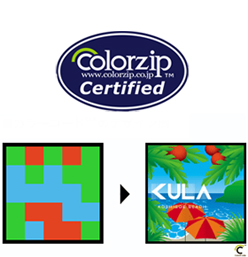
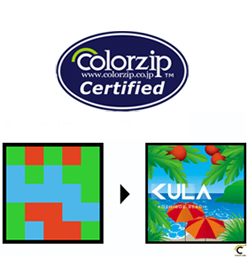
ColorZip Japan now announces [ColorZip Certified Program] to give certificate to our trusted partners and their products. The program is set to find creative design or hardware companies who can cooperate with us to make the ColorCode designs or improve hardware. After thoroughly evaluating creativity, robustness of their product and technology, ColorZip's Partnership is certified and official logo is provided. With the ColorCode, you can appeal your reliability and expand business chances. Image Credit: ColorZip Japan, Inc.

Imagine the possibilities of reaching out to consumers on-the-fly when ColorCodes can be read quickly and easily from a 15 foot distance by mobile phones, Cell PDAs, PCs, and other devices equipped with cameras. Say good-bye to exclusively communicating through one-dimensional print display methodologies.

Excerpts from ColorZip Japan, inc. website -

There's a colorful new world to be explored.

Point your mobile phone at a model in a magazine ad and zip you're visiting her website.

Point your Cell PDA at a music video on TV and zip you've got a sample of the hit single.

Point your cell phone at your favorite team's logo and zip you know the score.
That's the power of ColorZip.

ColorZip works with mobile phones, PC cameras, and other imaging devices that read ColorCodes. Let's say you see a poster for a movie you're interested in. Point your mobile phone at it. The camera in your phone reads a ColorCode printed on the poster. The ColorCode contains information provided by a server. The server then sends data to your phone in the form of content, perhaps a movie trailer. Best of all, it happens instantly, in a zip.


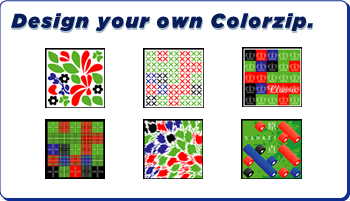
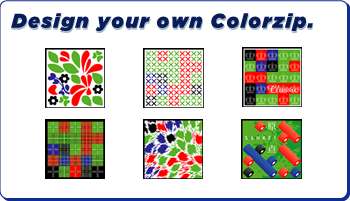
The ColorCode was exhibited at the AUTO-ID EXPO by SATO (printers) held at TOKYO BIG SIGHT. The flower motif ColorCode is for use on flower tags at a florist or nursery. Image Credit: ColorZip Japan, Inc.

Every picture tells a story.

ColorZip also makes watching TV an interactive experience. Suppose you see a product you like on a TV show or commercial. Point your mobile phone at the screen and zip, you can order the product. Perhaps you're watching a TV quiz show. With ColorZip you could play along from home, "answering questions" with your phone and instantly winning prizes.

There are more than 17 billion color patterns available in a 3 mm square code, and in larger codes the possibilities are infinite. Codes can be created in wide variety of shapes, sizes and colors and printed on paper, fabric, glass and other materials. They can appear as corporate and brand logos, designer labels, photos, and virtually anything you can imagine.


It's only a matter of time before the world around you is painted with ColorCodes. Wherever you go, wherever you look -- TV, magazines, store shelves, shopping bags, billboards, web banners, T-shirts and more -- you'll see ColorZip in action.
All you need to do is zip.
Reference Here>>


ColorCodes from Origin through Mobile Site have been designed by the Sankei Co Ltd.'s desingners. The design represents their corporate profile and philosophy. Image(s) Credit: ColorZip Japan, Inc.

Excerpts from Newsweek International via MSNBC early this year-

Using Color Codes To Browse the Web
By Christian Caryl (with B. J. Lee in Seoul) - Newsweek International - Jan. 16, 2006 issue

It's an advertiser's dream. Imagine you're sitting in your favorite cafe when something in the business pages catches your eye. That company you're reading about sounds intriguing. So you take out your mobile phone and focus the camera lens on a small splotch of color embedded in the corner of the article. Suddenly the phone's screen is displaying real-time stock prices and up-to-the-minute company headlines.

It's become a truism that the Internet is transforming the way businesses reach their customers. But among advertisers there's a nagging sense that the online world is still too disconnected from more traditional media, like print. For most users, gaining access to the Internet still means sitting in front of a computer and hammering away at a keyboard - a setup far removed from the experience of reading the morning paper or thumbing through a magazine. Advertisers would instead like to give print readers immediate access to the full range of Web-based information. Colorzip Media, a South Korea-based company, is one of the numerous small firms hoping to bridge this divide.

Colorzip's idea is to build on the pros of bar codes while shedding the cons. The intricate structure of bar codes makes them hard to read; scanners have to be close and precise. And if anything else gets in the way - an ad, for example - the scanner can't cope.


A few years ago Korean computer scientists came up with a new kind of code based on color patterns, which can be easily incorporated into company logos or other graphic designs. Colors are much easier for scanners to read, and they help users home in on the content. Colorzip codes have the added advantage of simplicity.
The design highlights the Skype logo and uses plenty of Skype light blue within the ColorCode. Image Credit: ColorZip Japan, Inc.

Unlike a data-heavy bar code, all a Colorzip code communicates when it's scanned is an index, a pathway to content stored on a server. That links the reading device to the desired content which then pops up on the screen.

Even better, the colors can be read at relatively long distances - say, half a meter away and at poor resolutions. Colorzip codes have already been used on TVs, for example, with viewers voting to express their preferences for the outcome of a show. You focus your phone's camera on a splotch of color in the corner of the screen and press the button; you then find yourself at a Web site.

"We're able to put content onto the code to make it attractive," says Christopher Craney, CEO of Colorzip's Japan subsidiary.
----
But who goes to the trouble of carrying around a scanner? The answer: 60 percent of mobile-phone users in South Korea and Japan. Their phones come with Quick Response readers, based on a code
[a 2D code - QR Code invented by DENSO WAVE CORPORATION] that's somewhere between bar codes and the version proposed by Colorzip. With some software from Colorzip, users can zap everything from specially made Colorzip postage stamps issued by the postal service to T shirts or caps marked with jazzy graphics, and be directed to a Web site.

The technology has a drawback. Because the codes can be photographed or copied, they might be susceptible to hacking.
----
But the color codes may presage a day when the combination of user-friendly codes and the Google-sifted Net universe opens up myriad possibilities.
Read All>>

Check out the most powerful 3D/Auto ID "Cubed" code designed to date>>